
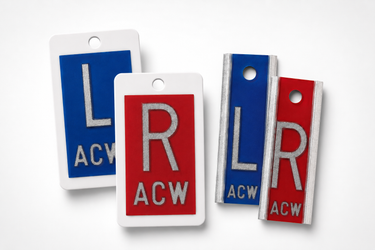
A Guide to Our X-Ray Markers
May 13th 2026
Proper anatomical markers are one of the most fundamental quality standards in diagnostic imaging. An image without a visible R or L marker, or with markers that are illegible or placed incorrectly, can result in rejected images, repeat exposures, and in the worst case, wrong-side errors that compromise patient outcomes.
Marker selection is something most departments handle on autopilot. Techs inherit whatever markers their department has always used, and the purchasing decision often comes down to whatever’s cheapest on the supply order. There are, however, real differences between marker types that affect image quality, workflow, infection control, and compliance.
Aluminum Markers: The Clinical Standard
Aluminum markers, also called lead markers or Pb markers, are the traditional choice for permanent-use radiographic identification. They consist of lead letters (R, L, or custom initials) embedded in a clear or colored plastic housing, and they produce clean, high-contrast identification on the finished image.
Aluminum markers produce consistent, clearly legible identification across a wide range of exposure techniques, they’re durable enough to last years with proper care, and they’re available with custom initials so each technologist carries their own personalized set. This personalization matters for accountability when an image is reviewed because the marker identifies which tech acquired it.
The tradeoff is that aluminum markers require cleaning between patients (they’re a potential fomite), they can be lost or borrowed and not returned, and they represent a per-technologist cost that adds up when staffing turns over.
Plastic Markers: Lightweight and Cost-Effective
Plastic markers use radiopaque lettering embedded in a lightweight plastic body. They’re less expensive than aluminum markers and work well for departments that need a supply of general-use R/L markers without the cost of individualized sets.
Plastic markers are a practical choice for high-volume departments that go through markers quickly, training programs where students need affordable markers, and facilities that prefer to standardize on department-owned markers rather than individual technologist sets. They’re also available in multiple colors, which can help with room or department color-coding systems.
Disposable Markers: Single-Use Infection Control
Disposable markers are designed for single-patient use and are discarded after the exam. They address the infection control concern directly: there’s no marker traveling from patient to patient, no cleaning step to forget or rush through, and no cross-contamination risk.
This makes disposable markers particularly relevant for isolation rooms, operating rooms, trauma bays, and any environment where infection control protocols are strict. The per-unit cost is low, and the elimination of the cleaning step can save time in high-throughput environments.
The limitation of disposable markers is that they don’t carry technologist-specific identification. For departments where accountability tracking requires individual tech ID on every image, disposables may need to be paired with a secondary identification method.
Marker Placement Best Practices
Regardless of which marker type your department uses, placement standards matter as much as the marker itself. The marker should always be placed within the collimated field before exposure—never digitally added after the fact. Post-processing annotation does not meet most accreditation standards and is considered a quality deficiency by many state regulatory agencies.
The marker should be positioned so it’s clearly visible on the finished image without overlapping anatomy of interest. For extremity work, placing the marker near the edge of the collimation field on the lateral side being identified is standard practice. For chest and abdominal imaging, markers are typically placed in the upper corner of the image.
Building a Marker Program That Works
The most practical approach for most departments is a combination: personalized aluminum markers for full-time technologists, a supply of plastic markers for float staff and trainees, and disposable markers stocked in isolation and OR environments. Techno-Aide offers all three types along with marker supplies including marker pouches, tape, and cleaning accessories to support a complete marker program.
It’s a small line item in the department budget, but getting markers right eliminates a disproportionate number of repeat exposures and quality complaints.