
Cath Lab Radiation Protection
Jun 11th 2026
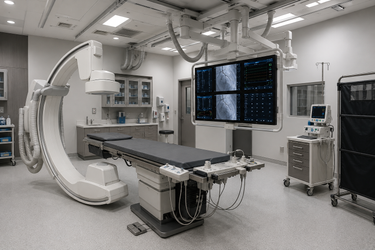
Cardiac catheterization laboratories represent one of the highest radiation exposure environments in healthcare. The combination of prolonged fluoroscopy times, complex patient anatomy, and the operator's proximity to the radiation source creates an occupational exposure profile that demands serious, sustained attention to protection strategy. The staff who work in cath labs are among the most highly skilled professionals in medicine and they deserve protection programs that match the sophistication of the procedures they perform.
Understanding the Exposure Environment
In a cath lab, the primary radiation beam passes through the patient, and scatter radiation radiates outward from the patient in all directions. The operator, typically standing at the patient's side near the femoral or radial access site, is exposed to this scatter for the duration of the procedure. A straightforward diagnostic catheterization might involve 10-15 minutes of fluoroscopy time. A complex percutaneous coronary intervention (PCI) can exceed 60 minutes.
Research has documented approximately a 10x difference in scatter dose rate between the tube side and the detector side of the patient. Operators who consistently position themselves on the detector (image receptor) side of the C-arm receive dramatically less scatter than those on the tube side. This single positioning principle is one of the most powerful dose-reduction tools available and it costs nothing.
Protection Strategies That Work
Body-Worn Protection
Vest-and-skirt systems: Two-piece systems that distribute weight between the shoulders and hips are strongly preferred over single-piece aprons for cath lab use. The weight redistribution reduces cervical and lumbar spine loading during multi-hour procedures.
Lightweight materials: Lead-composite and lead-free materials reduce garment weight by 25-40% while maintaining stated attenuation. For staff wearing protection for 6-8 hours per day, the cumulative weight reduction is significant.
Thyroid protection: Thyroid shields should be standard equipment for all cath lab personnel. The thyroid gland is radiosensitive, and the elevated scatter environment in a cath lab makes thyroid protection non-negotiable.
Eye protection: Leaded glasses or face shields protect against radiation-induced cataracts. Studies have found that 38% of interventional cardiologists develop posterior lens opacities which may attribute to occupational radiation exposure. Leaded eyewear is a simple, effective countermeasure.
Room-Based and Supplementary Shielding
Table-mounted drapes: Lead-equivalent drapes that hang from the table edge intercept scatter radiation below the table, protecting the operator's lower extremities.
Mobile barriers: For circulating nurses, anesthesiologists, and other personnel who are in the room but not at the table, mobile barriers provide flexible protection that can be positioned based on the specific procedure geometry.
Dose Monitoring and Accountability
Every person who regularly works in a cath lab should wear dosimetry. The standard approach uses two badges: one at the collar (outside the apron) to estimate head and thyroid dose, and one at the waist (under the apron) to estimate effective body dose. Fetal monitors should be added for any declared pregnant worker.
Real-time dose monitoring systems that display cumulative dose during the procedure are gaining adoption in high-volume labs. These systems provide immediate feedback that helps operators modify technique, positioning, and shielding in real time rather than discovering high exposure readings weeks later during badge review.
Building a Culture of Safety
The most effective cath lab radiation safety programs combine good equipment with good habits. Regular training on positioning principles, proper garment donning, and dose awareness should be part of ongoing education, not a one-time orientation module. Senior operators who model safe practices set the standard for the entire team.
Techno-Aide manufactures radiation protection equipment used in catheterization labs across the country. Our vest-and-skirt systems, thyroid shields, mobile barriers, and lightweight garment options are designed for the unique demands of interventional environments where protection must be excellent and wearable for hours at a time.