
Don't Forget Your Glasses!
Jul 27th 2026
Of all the radiation protection equipment in an imaging department, leaded eyewear may be the most underused but most important for long-term career health. Research shows that 50% of interventional cardiologists develop cataracts, and the International Atomic Energy Agency reports that properly fitted lead glasses can reduce radiation dose to the lens of the eye by up to 90%. Yet many departments either don't stock leaded eyewear or stock styles so uncomfortable that staff avoids wearing them.
Choosing the right lead glasses is about balancing protection level, comfort, fit, and durability. This guide covers what you need to know to make that choice.
Why Eye Protection Matters More Than You Think
The lens of the eye is one of the most radiosensitive tissues in the body. Unlike most radiation-related cancer risks, which involve stochastic (probabilistic) effects, radiation-induced cataracts are a deterministic effect as they develop predictably once cumulative dose exceeds a threshold. Recent research suggests that threshold may be far lower than previously believed, with some studies suggesting cataracts may form without any threshold at all at low-radiation doses.
In 2011, the International Commission on Radiological Protection (ICRP) reduced the recommended annual dose limit for the lens of the eye from 150 mSv to 20 mSv. This change reflected growing evidence that posterior subcapsular cataracts develop at lower doses than previously thought, particularly in interventional radiology and cardiology staff who spend extended periods near fluoroscopic scatter fields.
A posterior subcapsular cataract can directly impair the visual acuity that interventional physicians need to perform precise, image-guided procedures. For many, it's a career-altering diagnosis.
Lead Equivalency: What the Numbers Mean
Lead glasses are rated by their lead equivalency, expressed in millimeters of lead (mm Pb). Most radiation protection eyewear offers 0.75mm Pb equivalency, which provides substantial attenuation of scattered radiation at the energy levels typical in diagnostic imaging and fluoroscopy.
It's important to understand that lead glasses protect against scatter radiation which is the secondary radiation that emanates off the patient and surrounding structures during a procedure. They are not designed for direct beam exposure. The attenuation provided by 0.75mm Pb is well-suited for the scatter energies encountered in diagnostic and interventional settings.
Frame Styles: Finding What Your Staff Will Actually Wear
The most protective glasses in the world provide zero benefit if they sit in a drawer because they're uncomfortable. This is why frame selection matters as much as lead equivalency. Techno-Aide offers 15 distinct lead glasses models specifically to address the reality that different staff members need different fits and styles.
Wraparound Sport Frames
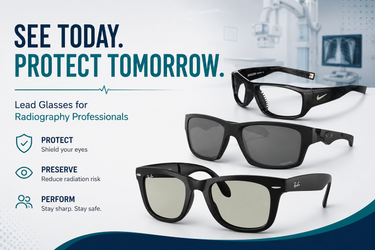
Models like the Onyx, Razer, and Nike Brazen use wraparound sport-style frames that provide excellent lateral coverage while maintaining a contemporary appearance. The wraparound design blocks scatter radiation that would otherwise enter from the sides which is a significant advantage over flat-front frames. These models are popular with younger staff and those who want protective eyewear that looks like regular glasses.
Classic and Professional Frames
The Ray-Ban 4105 Folding Wayfarer and Oakley Jupiter Squared bring recognizable designer aesthetics to radiation protection. For staff who resist wearing clunky, industrial-looking protective eyewear, designer-frame options can dramatically improve compliance. The familiar styling reduces the psychological barrier to wearing leaded eyewear consistently.
Ultralite and Economy Options
The 99 Ultralite and 9941 Ultralite models prioritize weight reduction. Every gram matters when you're wearing eyewear for a four-hour interventional case. These lightweight frames use optimized lead distribution to maintain protection while minimizing fatigue.
Fitovers for Prescription Wearers
Staff who wear prescription glasses face a particular challenge: they need radiation protection that works with their existing eyewear. The Fitguard Beta and Fitguard Alpha Fitovers are designed to fit over most prescription frames, eliminating the need for expensive prescription leaded lenses. This approach is also more practical for departments where multiple staff members share protective eyewear, and fitovers accommodate different prescriptions without requiring individual pairs.
Goggles for Maximum Coverage
The Comet Goggles and Astroflex 70s provide the highest level of orbital coverage with sealed or semi-sealed designs that block scatter from virtually every angle. These are ideal for high-exposure environments like cardiac catheterization labs and interventional neuroradiology suites where operators work near intense scatter fields for extended periods.
Side Shields and Lateral Protection
A 2020 study published in the Journal of Vascular Surgery found that standard lead eyewear may not significantly reduce eye radiation dose because most of the scattered radiation penetrates the operator's eye obliquely from the sides and below, not straight ahead. Modified eyewear with added lead shielding along the lateral and inferior borders of the frame significantly improved dose reduction.
This research underscores why wraparound frames, goggle-style options, and models with integrated side shields consistently outperform flat-front frames in clinical dose measurements. When evaluating lead glasses, look beyond the frontal lead equivalency and consider the total solid angle of protection the frame provides.
Care, Storage, and Lifespan
Store glasses in a hard case or on a dedicated rack when not in use. Clean lenses with a soft cloth and mild soap; avoid abrasive cleaners that can scratch coated lenses. Inspect frames regularly for loose screws, bent temples, or cracked nose pads that affect fit and coverage.
Replace glasses when the frame no longer holds its adjusted position, when lenses become pitted or scratched to the point of impairing vision, or when physical damage to the frame compromises the protective envelope.
Building an Eyewear Program
Departments that achieve high compliance with leaded eyewear typically share a few characteristics: they stock multiple frame styles in multiple sizes, they store glasses accessibly, and they include eyewear in orientation and annual safety training. Making leaded eyewear convenient and comfortable removes the two biggest barriers to consistent use.
Techno-Aide's leaded eyewear line includes 15 models ranging from economy options to designer frames, with fitover models for prescription wearers and goggle options for maximum coverage. Our team can help you select a mix of styles that matches your department's workflow and staff preferences.