
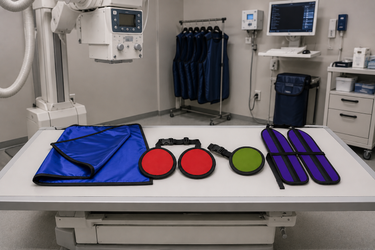
Essential Patient Radiation Shielding Accessories
May 6th 2026
Most of the conversation around radiation protection in imaging departments focuses on staff—and for good reason. Technologists and nurses accumulate occupational dose over years and thousands of procedures. But patients deserve thoughtful protection too, particularly when radiosensitive anatomy is in or near the primary beam or scatter field.
Patient shielding products are designed to protect specific anatomical regions during diagnostic imaging exams. They’re simple, inexpensive, and fast to apply—and they demonstrate to patients that your facility takes their radiation exposure seriously.
The Current State of Patient Shielding Guidelines
It’s worth acknowledging that patient shielding guidelines have evolved in recent years. Several professional organizations, including the AAPM, have recommended against routine use of patient contact shielding in certain scenarios, primarily because modern automatic exposure control (AEC) systems can increase dose when shielding is detected in the beam path. This has led some facilities to reduce or eliminate routine gonadal shielding during pelvic and abdominal imaging.
However, the guidance is not universal. Many state regulations still require patient shielding in specific circumstances, and shielding remains widely recommended when the protected anatomy is outside the primary beam but within the scatter field. The practical takeaway: imaging departments still need patient shielding products, but the clinical protocols for when and how to use them should reflect current best practices and local regulatory requirements.
Gonadal Guards
Gonadal guards are the most widely recognized form of patient shielding. Available in small, medium, and large sizes—or as a convenient three-size bundle—these flat or contoured shields are placed over the reproductive organs when they’re in proximity to the radiation field but not part of the anatomy being imaged.
Common applications include hip imaging in younger patients, lumbar spine studies, and any exam where the gonads are adjacent to the collimated field. Techno-Aide’s gonadal guards are available with 0.5mm Pb or 1.0mm Pb equivalent protection and range from $72 to $280.
Breast Guards
Breast guards protect breast tissue during imaging exams where the chest is near the field of interest but not the primary anatomy being studied. They’re particularly relevant for scoliosis series in adolescent females, where repeated full-spine imaging over several years creates a meaningful cumulative dose to breast tissue.
Available in child and adult sizes, breast guards are lightweight, easy to position, and can be quickly applied without significantly extending exam time. Techno-Aide’s breast guards range from $50 to $110.
Scolio Guards
Scolio guards are purpose-built for scoliosis imaging protocols. Adolescent scoliosis monitoring typically involves serial full-spine radiographs taken every 6–12 months over several years of growth—a cumulative exposure pattern that makes shielding particularly important for this patient population.
Techno-Aide’s Scolio Guards feature an adjustable one-size-fits-all design that positions shielding over radiosensitive anatomy while leaving the spine visible for measurement. At $149, they’re a small investment for a product that serves a clinically important and recurring use case.
Blanket Guards
Blanket guards are the most versatile patient shielding product. These flexible, drape-style shields can be placed over any body region that needs protection—abdomen, chest, pelvis, or extremities. They’re especially useful in scenarios where standard-shaped guards don’t fit the anatomy or positioning requirements.
Techno-Aide offers blanket guards in multiple sizes from small to extra-large, with 0.5mm Pb or 1.0mm Pb equivalent options. They range from $121 to $1,564 depending on size and lead equivalency, making them suitable for everything from targeted organ protection to broader coverage during interventional procedures.
Stocking Your Department
A practical patient shielding inventory for a general radiology department typically includes: a set of gonadal guards in multiple sizes, breast guards in child and adult sizes, at least one scolio guard if your facility does scoliosis monitoring, and a selection of blanket guards for flexible coverage. Keeping these accessible in each imaging room—rather than stored in a central closet—dramatically increases actual usage rates.
All Techno-Aide patient shielding products are manufactured in the USA and designed for the quick application and easy cleaning that busy imaging departments require.