
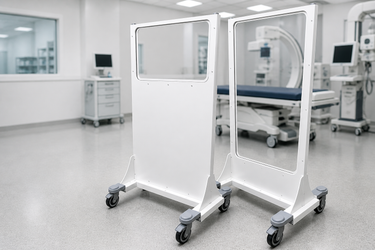
Mobile Barries: Heavy Duty Protection
May 5th 2026
Mobile Radiation Barriers: When Wearable Protection Isn’t Enough
Lead aprons, vests, and skirts systems are the foundation of occupational radiation protection, but there are clinical scenarios where wearable protection alone is not sufficient. The combination of prolonged exposure time, high scatter output, and proximity to the radiation source can demand an additional layer of structural shielding between the operator and the beam.
That’s the role mobile radiation barriers fill. They’re not a replacement for protective apparel but rather the second line of defense for environments where scatter radiation levels are highest and exposure durations are longest.
Where Mobile Barriers Make the Biggest Difference
Not every imaging room needs a mobile barrier. But in certain clinical settings, the scatter radiation environment is intense enough that wearable protection alone leaves staff with more cumulative dose than necessary. The departments where mobile barriers are most common share a few characteristics: prolonged fluoroscopy time, close operator proximity, and procedures that generate high levels of scatter.
Cardiac Catheterization Labs
Cath lab procedures routinely involve 20–60 minutes of continuous or near-continuous fluoroscopy. The operator stands close to the patient and the C-arm, and scatter radiation levels at operator position are among the highest in any imaging environment. A mobile barrier positioned between the operator and the primary scatter source can significantly reduce whole-body and extremity dose accumulation over the course of a shift.
Interventional Radiology
IR suites face similar exposure profiles to cath labs, with the added complexity that procedures can run longer and involve higher kV settings depending on the anatomy. Mobile barriers are particularly valuable for circulating staff and nurses who may not be wearing the same level of protective apparel as the primary operator.
Operating Rooms with C-Arm Fluoroscopy
Orthopedic, vascular, and pain management procedures frequently use C-arm fluoroscopy in the OR. The surgical team’s focus is on the procedure, not on radiation geometry, and the OR layout often places staff in high-scatter zones without them realizing it. A mobile barrier provides passive protection that doesn’t require the team to change their workflow.
Bedside and Portable Imaging
In ICU and emergency settings, portable x-ray imaging may occur in open rooms with other patients and staff nearby. A mobile barrier shields individuals who aren’t involved in the exam but are in proximity to the radiation source.
Leaded Glass vs. Leaded Fabric Barriers
Mobile barriers come in two fundamental designs, and choosing between them depends on what you need the barrier to do.
Leaded glass barriers feature transparent upper sections made from high-quality Schott® leaded glass, typically rated at 2.0mm Pb equivalent. These allow the operator or circulating staff to maintain a clear line of sight to the patient and procedure while still receiving structural shielding. They’re ideal for cath labs, IR suites, and ORs where visual access is critical. Techno-Aide offers standard, compact window, specialty window, and adjustable height configurations.
Leaded fabric mobile shields use flexible radiation-attenuating fabric mounted on rolling frames. They’re lighter, more maneuverable, and less expensive than glass barriers, making them a practical choice for portable imaging environments, bedside use, and departments that need to move barriers frequently between rooms. Techno-Aide’s mobile shields come in H-base, T-base, and Star-base configurations, with adjustable height and 0.5mm Pb equivalent protection.
Choosing the Right Configuration
The base design matters more than most buyers realize. It determines stability, footprint, maneuverability, and clearance which affect whether the barrier actually gets used in practice.
H-base (Premium): The widest, most stable footprint. Ultra-low clearance glides under beds and tables. Best for permanent or semi-permanent placement in cath labs and IR suites where stability is paramount.
T-base (Standard): A balanced option between stability and maneuverability. Low-clearance design still fits under most equipment. Good for departments that move barriers between rooms regularly.
Star-base (Economy): The most compact and maneuverable option. Five-point base provides solid stability in a smaller footprint. Best for facilities that need affordable, portable scatter shielding across multiple areas.
What to Consider Before Purchasing
When evaluating mobile barriers for your department, the key questions are practical ones. How much floor space do you have around the procedure table? Will the barrier need to fit under beds or equipment? Does the operator need to see through the barrier during the procedure? How often will it be moved between rooms? And what’s the typical fluoroscopy time for the procedures being performed?
Departments with long fluoroscopy times and high procedure volumes will see the most return from leaded glass barriers. Departments doing occasional portable imaging or looking to protect nearby staff will find leaded fabric shields more than adequate. Many facilities end up with both types deployed in different areas.
All Techno-Aide mobile barriers are manufactured in the USA and built with durable frames designed for the demands of busy clinical environments.