
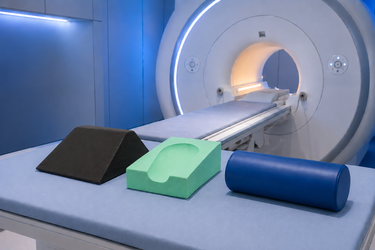
MRI Safe Patient Positioning
May 14th 2026
Magnetic Resonance Imaging presents a unique challenge that doesn't exist in any other modality in that everything in the scan room must be MRI-safe. There's no tolerance for error. Patient positioning in MRI requires careful selection of materials, purpose-built accessories, and a workflow that accounts for the magnetic environment from the moment the patient enters Zone IV.
Why MRI Positioning Is Different
In conventional radiography, positioning aids often contain materials that would be catastrophic in an MRI suite. Metal snaps, wire reinforcements, ferromagnetic buckles, and even certain foam formulations with metallic contaminants can cause problems ranging from image distortion to serious patient injury.
MRI-safe positioning products are manufactured specifically to eliminate these risks. They use non-ferromagnetic materials throughout including fasteners, structural supports, and surface coatings. The distinction between "MRI-safe" (poses no known hazard in any MRI environment) and "MRI-conditional" (safe under specific conditions) matters, and every positioning accessory brought into the scan room should have clear documentation of its MRI status.
Essential MRI Positioning Accessories
Foam Sponges and Pads
MRI-compatible foam sponges are the workhorse of MR positioning. They're used to support joints, fill anatomical gaps, immobilize extremities, and maintain patient comfort during scans that can last 30-60 minutes or more. Unlike radiolucent sponges used in x-ray (which may contain barium sulfate or other radiopaque markers), MRI sponges must be completely free of metallic content.
Common shapes include wedges, bolsters, rectangles, and anatomically contoured pads for knee, shoulder, and spine imaging. Having a comprehensive assortment on hand eliminates the temptation to improvise with non-approved materials which is a common source of MRI safety incidents.
Head and Neck Positioning
Brain and cervical spine imaging require precise, reproducible head positioning. MRI-compatible head holders, chin straps, and forehead restraints keep the patient still without introducing signal artifacts. Foam ear pads serve double duty: they position the head within the coil and provide hearing protection from the scanner's acoustic noise, which can exceed 100 dB in some sequences.
Extremity Positioning
Wrist, elbow, knee, and ankle imaging frequently require the joint to be held at specific angles for optimal visualization. MRI-compatible angle sponges and extremity holders maintain these positions throughout the scan without patient effort which is critical since any movement during acquisition degrades image quality and may necessitate repeat sequences.
Body and Spine Support
Long spine protocols and body imaging benefit from consistent, comfortable support. MRI-compatible table pads reduce pressure points during extended scan times, improving patient tolerance and reducing motion. Knee bolsters placed under the legs during supine positioning relieve lower back strain and meaningfully improve patient comfort and cooperation.
Patient Comfort: The Hidden Image Quality Factor
MRI scans take time. A routine brain MRI might take 20-30 minutes. A comprehensive spine study can exceed an hour. During that time, patient movement is the enemy of image quality. Every shift, twitch, or repositioning attempt can create motion artifacts that require sequences to be repeated.
Proper positioning is about anatomy and making the patient comfortable enough to hold still. A well-positioned patient who feels supported and secure will produce better images in fewer attempts than one who's uncomfortable and anxious. Investing in quality positioning accessories pays for itself in reduced scan times and fewer repeat acquisitions.
Sanitation and Infection Control
MRI positioning aids should be easy to clean between patients. Look for closed-cell foam options with wipeable vinyl or coated covers that resist fluid penetration and can be disinfected with standard hospital-grade cleaning solutions. Open-cell foam absorbs moisture and body fluids, creating infection control concerns that are difficult to remediate.
Facilities with high throughput should establish a cleaning protocol for positioning accessories that matches their table and coil cleaning schedule. It's easy to overlook sponges and pads in the decontamination workflow, but they contact patients just as directly as the imaging table.
Building Your MRI Positioning Inventory
A well-stocked MRI suite should have: head sponges in multiple sizes, knee and ankle bolsters, wedge sponges (various angles), flat table pads for comfort, extremity positioning blocks, and sandbag alternatives (non-ferromagnetic weighted bags for immobilization). Everything should be clearly labeled as MRI-safe, and non-MRI-safe items should be physically excluded from the scan room.
Techno-Aide manufactures MRI-compatible patient positioning products alongside our full line of radiology accessories. Every product intended for MRI use is manufactured with verified non-ferromagnetic materials. Our Nashville production facility has been serving imaging departments for over four decades so we understand that in MRI, material verification isn't optional.