
Occupational Radiation Dose Limits
Jun 11th 2026
Radiation dose limits exist to define the maximum exposure levels that regulatory authorities consider acceptable for occupational radiation workers. Knowing these numbers matter because understanding the framework helps you contextualize your own dose readings, evaluate your department's safety practices, and make informed decisions about protection.
The Current Regulatory Framework
In the United States, occupational radiation dose limits are established by the Nuclear Regulatory Commission (NRC) in 10 CFR Part 20. These limits apply to all occupational radiation workers, including radiologic technologists, radiologists, nuclear medicine staff, interventional cardiology teams, and anyone else who works with or near ionizing radiation in a professional capacity.
Individual states may adopt these federal limits directly or implement more restrictive standards through their own regulations. Always check your state's requirements, as some states have adopted dose limits below the federal thresholds.
Key Dose Limits You Should Know
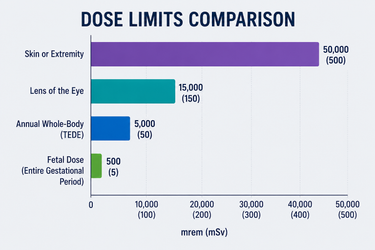
Total Effective Dose Equivalent (TEDE): 5,000 mrem (50 mSv) per year. This is the whole-body limit for occupational workers and represents the sum of external deep dose equivalent and committed effective dose equivalent. It's the number most referenced in radiation safety discussions.
Lens of the Eye: 15,000 mrem (150 mSv) per year under current NRC regulations. However, the International Commission on Radiological Protection (ICRP) has recommended lowering this to 2,000 mrem (20 mSv) per year based on evidence that radiation-induced cataracts occur at lower doses than previously thought. Some countries have already adopted the lower limit, and it's likely that US regulations will follow.
Skin or Extremity Dose: 50,000 mrem (500 mSv) per year to the skin or any individual extremity. This limit is particularly relevant for interventional staff whose hands work near the radiation field during fluoroscopy-guided procedures.
Fetal Dose: 500 mrem (5 mSv) for the entire gestational period after a formal declaration of pregnancy. This is roughly one-tenth of the annual TEDE limit for adult workers and reflects the heightened radiosensitivity of the developing fetus.
Why Most Professionals Never Approach These Limits
Technologists in higher-exposure environments like fluoroscopy, interventional radiology, cardiac catheterization may accumulate higher doses, but well-run departments with proper shielding, distance management, and barrier use generally keep even these readings well below action levels.
The professionals most likely to approach dose limits are those in high-volume interventional practices with suboptimal protection practices, those who consistently work without proper protective equipment, or those affected by equipment malfunctions or procedural incidents.
Action Levels vs. Dose Limits
Smart departments don't wait until someone reaches a dose limit to act. Instead, they establish action levels with dose thresholds below the regulatory limit that trigger investigation and corrective measures.
A typical action level framework might work like this: if a worker's quarterly dose exceeds 125 mrem (10% of the annual TEDE limit per quarter), the RSO investigates to identify the cause. If quarterly dose exceeds 500 mrem, immediate corrective action is required and work assignments may be modified, equipment checked, and practices reviewed. The regulatory limit of 5,000 mrem annually should never be viewed as a target or acceptable operating level. It's a ceiling that a well-managed program never approaches.
Practical Steps for Staying Well Below Limits
Wear your badge consistently: A dosimetry badge only works if it's worn properly, every shift, in the correct location. Badge readings that show "zero" because the badge was left in a locker provide no useful data.
Review your reports: When dosimetry reports are distributed, look at your numbers. Understand what they mean. If you don't know how to interpret your readings, ask your RSO.
Wear appropriate protection: Lead aprons, thyroid collars, leaded glasses exist because they work. Consistent use of proper protective equipment is the most direct control you have over your occupational dose.
Maximize distance: Every additional foot of distance from the radiation source reduces your dose. Use exposure cords fully, stand behind barriers when available, and position yourself thoughtfully during fluoroscopy.