
Protection Glove's Impact Hand Radiation Dosage
Aug 10th 2026
For years, the use of radiation protection gloves during fluoroscopically guided interventions has been debated. Some clinical guidelines recommended against protective gloves, citing concerns that the added lead material could trigger automatic exposure control systems to increase radiation output that would potentially expose the operator to more scatter radiation than they'd receive with bare hands.
New research published in 2025 has fundamentally challenged that guidance, and the findings are significant for anyone who works with their hands near a fluoroscopic beam.
The 2025 Research: Gloves Work Without the Feared Tradeoff
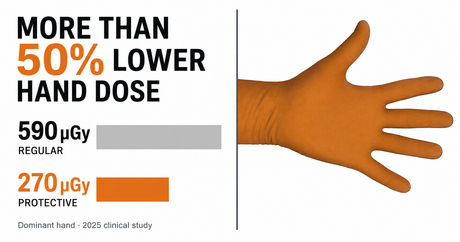
A study presented at the 2025 Vascular Annual Meeting directly tested whether radiation protection gloves reduce hand dose and whether they increase overall operator exposure. The results were clear: both dominant and nondominant hand radiation doses were significantly lower with protective gloves (270 μGy vs. 590 μGy for the dominant hand, and 260 μGy vs. 660 μGy for the nondominant hand). That's a reduction of more than 50% for both hands.
Critically, the study found no significant difference in procedural radiation absorption dose, fluoroscopy time, or dose area product when comparing procedures performed with regular gloves versus protective gloves. The feared tradeoff that protective gloves would trigger higher machine output and more scatter did not materialize in clinical practice.
A separate 2025 study confirmed these findings, reporting that leaded gloves reduced hand radiation exposure by approximately 80% per procedure, with annual cumulative dose for professionals using leaded gloves being five times lower than for those using regular gloves. Again, no increase in whole-body scattered radiation exposure was observed.
Why Hand Dose Matters
The regulatory dose limit for extremities (hands and feet) is 500 mSv per year which is ten times the whole-body limit. That relatively high number can create a false sense of security. In practice, interventional operators who perform high-volume fluoroscopic procedures can accumulate significant hand doses over a career, particularly in the dominant hand that manipulates catheters, guidewires, and other devices near the primary beam.
Radiation effects on the hands include skin erythema (reddening), desquamation (skin peeling) at high acute doses, and, with chronic cumulative exposure, increased risk of radiation dermatitis and skin damage that can affect dexterity and professional function. While catastrophic hand injuries from diagnostic-level fluoroscopy are rare, subclinical skin changes accumulate over years of practice.
For vascular surgeons, interventional cardiologists, and interventional radiologists who may perform thousands of fluoroscopic procedures over a career, hand protection is a long-term occupational health consideration.
Techno-Aide Radiation Protection Gloves
Techno-Aide offers four radiation protection glove options, developed in collaboration with Emerson & Co. and designed to meet ASTM standards and FDA requirements for medical use in operating environment.
XGuard Glove
The XGuard provides radiation attenuation in a surgical-style glove format. It's designed for operators who need dexterity during interventional procedures while maintaining hand protection. The XGuard balances tactile sensitivity with meaningful dose reduction addressing the primary complaint operators have about older, thicker protective gloves that compromised fine motor control.
FreeGuard Glove
The FreeGuard is designed for procedures where maximum dexterity is required. Its construction prioritizes finger mobility while still incorporating radiation-attenuating material. For operators who perform catheter-based procedures requiring precise tactile feedback, the FreeGuard represents a compromise between protection and procedural performance.
Premium Mitts with Palm Slit
For situations where the operator's hands are near but not directly in the beam field, such as holding retractors or stabilizing equipment during fluoroscopic procedures, Premium Mitts provide hand and forearm coverage. The palm slit design allows the mitt to be quickly donned or adjusted without removing other gloves, making them practical for dynamic OR environments.
Premium Finger Gloves
The Premium Finger Gloves offer full-finger radiation protection for operators who need individual finger dexterity with comprehensive coverage. These are the most protective option in the lineup, suitable for high-volume interventional practitioners who consistently work in proximity to the scatter field.
Practical Considerations
Sterility and Infection Control
Radiation protection gloves are typically worn under sterile surgical gloves during interventional procedures. AORN's 2025 perioperative practice guidelines noted that reusable PPE such as lead gloves can have contamination rates between 62.5% and 100%, emphasizing the importance of regular cleaning protocols between uses. Departments should establish documented cleaning procedures and replacement schedules for reusable radiation protection gloves.
Cost vs. Career Protection
For high-volume interventional practices, this investment should be evaluated against the career-spanning benefit of reduced cumulative hand dose. The 2025 research showing 80% dose reduction per procedure means that over a 25-year interventional career, the cumulative dose savings are substantial.
Sizing and Fit
Like all radiation protection equipment, gloves only work if they fit properly and are worn consistently. Poorly fitting gloves impair dexterity and create gaps in coverage. Techno-Aide offers sizing guidance to ensure operators get gloves that provide both protection and the tactile performance their procedures demand.
The science on radiation protection gloves has evolved significantly. The 2025 data creates a compelling case for incorporating hand protection into the standard protective equipment suite for fluoroscopy-intensive practices. Techno-Aide's glove line provides options across the protection-dexterity spectrum.