
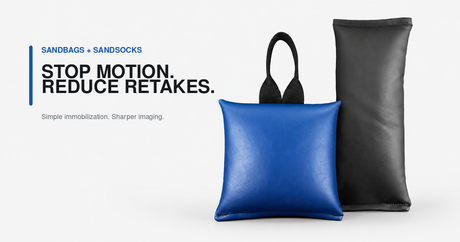
Sensational Sandbags & Sandsocks
Aug 3rd 2026
Ask any experienced radiologic technologist what causes the most retakes, and the answer is almost always motion. Patient movement during the exposure whether voluntary or involuntary produces motion blur that degrades image quality and often necessitates a repeat exposure. Every repeat means additional radiation dose to the patient, additional time for the technologist, and additional disruption to the department's workflow.
Sandbags and sandsocks are among the simplest and most effective tools for preventing motion-related retakes. They provide passive immobilization by adding gentle weight that stabilizes the anatomical area being imaged. They require no power, no setup, and no specialized training. Yet many departments understock immobilization aids or make do with worn-out, undersized options that don't adequately stabilize patients.
Why Immobilization Matters for Dose and Quality
Every repeat exposure adds to the patient's cumulative radiation dose. In a busy department performing hundreds of exams per day, even a modest repeat rate translates to significant unnecessary population dose over time. Studies consistently show that motion is the leading technical cause of repeat radiographs, ahead of positioning errors and exposure technique problems.
Effective immobilization also improves diagnostic confidence. An image where the anatomical structures are sharp and well-defined gives the interpreting physician more information to work with than one where motion blur obscures fine detail. Better images lead to better diagnoses — it's that straightforward.
Sandbags vs. Sandsocks: What's the Difference?
Sandbags
Techno-Aide's sandbags are constructed with heavy-gauge vinyl encasements filled with clean, sifted sand. They come in rectangular and square configurations in a range of weights. The rigid, dense construction of sandbags makes them ideal for stabilizing larger body parts. Common examples would include holding a lateral knee in position, immobilizing a forearm for a wrist study, or providing counterweight against rotation during a hip exam.
The heavy-gauge vinyl is designed for the demanding environment of a radiology department that deals with frequent handling, repeated cleaning with hospital-grade disinfectants, and the inevitable drops and tosses that come with high-volume clinical use. Unlike fabric-encased sandbags, vinyl-covered bags can be fully surface-decontaminated between patients.
Sandsocks
Sandsocks are flexible, conformable tubes filled with sand that can be draped, wrapped, and shaped around anatomical contours. Where sandbags provide rigid stabilization, sandsocks provide adaptable conformity. They're particularly useful for immobilizing irregular body parts. Common instances would include, wrapping around a pediatric limb, draping over a shoulder to prevent rotation, or positioning alongside a foot for a lateral view.
The flexible vinyl construction of sandsocks allows them to follow the curve of the anatomy rather than bridging across it, which provides more effective contact-based immobilization. This conformability makes sandsocks especially useful in pediatric imaging, where small body parts and irregular contours make rigid immobilization difficult.
MR-Safe Immobilization
Standard sandbags cannot be used in the MRI environment. The metallic content (standard sand may contain ferromagnetic particles) and certain vinyl formulations make them unsafe near the strong magnetic field. Techno-Aide manufactures MR-Safe sandbags and sandsocks specifically for MRI suites, using non-ferromagnetic fill materials and MR-compatible encasements.
This distinction matters. Introducing standard sandbags into an MRI suite is a safety hazard as projectile risk in the magnet room is one of the most serious safety concerns in MRI. Dedicated MR-Safe immobilization aids should be clearly labeled and stored separately from conventional sandbags to prevent accidental cross-contamination between imaging areas.
Bundles: Equipping for Specific Needs
Rather than purchasing individual sandbags piecemeal, Techno-Aide offers pre-configured bundles designed for specific clinical needs:
General Bundle: A core assortment of sandbag sizes and weights suitable for a general radiography room. This bundle covers the most common immobilization scenarios encountered in routine diagnostic imaging.
Pediatric Bundle: Smaller, lighter sandbags and sandsocks sized for infants and children. Pediatric immobilization requires gentler weights and smaller contact areas. Using adult-sized sandbags on pediatric patients is both ineffective and uncomfortable.
Femoral/Angio Bundle: Sandbag sizes optimized for femoral access procedures, where post-procedure compression and immobilization of the groin site are critical for hemostasis.
MR-Safe Bundle: A complete MR-compatible sandbag set for equipping an MRI suite with safe immobilization aids from day one.
Practical Tips for Sandbag Programs
Stock generously. A department that runs short on sandbags during busy periods will see technologists improvise with rolled towels, tape, or verbal instructions to “hold still,” none of which match the effectiveness of proper weighted immobilization. Keep enough sandbags in each room that the technologist never has to leave the room to find one.
Clean between patients. Vinyl-covered sandbags and sandsocks can be wiped down with standard hospital disinfectants. Establish a cleaning protocol and follow it thoroughly because these devices contact patient skin and are shared across the department throughout the day.
Replace when worn. Sandbags with cracked vinyl, leaking sand, or degraded seams should be replaced promptly. A leaking sandbag creates a contamination and cleanup problem that far exceeds the cost of a replacement.
Techno-Aide's sandbag and sandsock line includes products ranging from small individual bags to comprehensive bundles, with MR-Safe options for MRI environments. Every unit is manufactured with heavy-gauge vinyl designed for the demands of clinical imaging.