
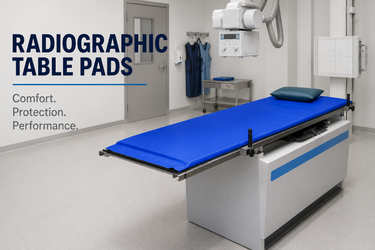
Table Pad Purposes
Jul 13th 2026
Imaging tables are designed for equipment performance, not patient comfort. The flat, hard surface of a radiography or fluoroscopy table serves its purpose to provide a stable, uniform surface for consistent image geometry, but it creates a patient experience problem. A patient lying on a cold, hard table is uncomfortable, anxious, and more likely to move during the exposure.
Table pads address this problem directly. A well-chosen pad transforms the patient experience from endurance test to manageable procedure, and the operational benefits such as fewer motion-related retakes, shorter exam times, and improved patient satisfaction, more than justify the investment.
The Connection Between Comfort and Image Quality
Patient motion is the leading technical cause of repeat radiographs. And the number one reason patients move during an exposure is discomfort. A patient who is cold, in pain from lying on a hard surface, or unable to hold an uncomfortable position will shift, tense, or flinch during the exposure producing motion blur that requires a repeat.
Table pads reduce motion by reducing discomfort. A patient lying on a padded surface can relax, which reduces involuntary muscle tension and the fidgeting that comes with discomfort. For longer procedures like fluoroscopy studies, interventional cases, MRI scans, the effect is even more pronounced. A patient who is reasonably comfortable at the five-minute mark is less likely to move than one who has been struggling against a hard surface since the beginning.
The math matters at scale. If table pads reduce motion-related retakes by even a small percentage across a department performing hundreds of exams per day, the cumulative reduction in unnecessary radiation dose, technologist time, and workflow disruption is significant.
Standard table pads use medical-grade foam in a vinyl encasement that covers the full length or a portion of the imaging table. The foam provides cushioning and insulation (addressing the cold-surface complaint), while the vinyl encasement allows thorough cleaning between patients. Standard pads are the most economical option and provide meaningful comfort improvement over a bare table surface.
Pressure Injury Prevention
For longer procedures like interventional cases, complex fluoroscopy studies, and MRI examinations, table pads serve a clinical safety function beyond comfort. Hospital-acquired pressure injuries (HAPIs) are a significant patient safety concern, and the hard surface of an unpadded imaging table creates exactly the conditions that promote pressure injury development: sustained pressure on bony prominences without redistribution.
While a 30-minute radiography table encounter is unlikely to cause a pressure injury in a healthy patient, patients who are elderly, malnourished, sedated, or have compromised circulation face elevated risk even during relatively short periods on hard surfaces.
Infection Control Considerations
Table pads contact every patient who lies on the table, making infection control a primary design consideration. Pads must have an impervious surface that can be cleaned with hospital-grade disinfectants between patients without degrading over time. Seams must be welded rather than sewn to prevent fluid infiltration. The pad surface must resist cracking, peeling, and delamination that would create harboring sites for bacteria.
Techno-Aide table pads are constructed with heavy-duty vinyl encasements featuring welded seams and antimicrobial surface treatments. The materials are compatible with standard hospital disinfectant protocols, including bleach-based solutions used during heightened infection control measures.
Sizing and Compatibility
Table pads need to fit the specific imaging table without interfering with table movement, bucky tray operation, or patient positioning. An ill-fitting pad that bunches, slides, or overhangs the table edge creates more problems than it solves including positioning inconsistency that affects image quality.
Techno-Aide manufactures table pads in standard dimensions that fit the most common imaging table platforms, with custom sizing available for non-standard configurations. Attachment systems, typically Velcro strips or under-table straps, keep the pad in position during use and allow quick removal for cleaning or when the table surface is needed uncovered.
Whether you're outfitting a single room or standardizing pad configurations across a multi-room department, Techno-Aide's table pad options provide the comfort upgrade that keeps patients still and exams on schedule.