
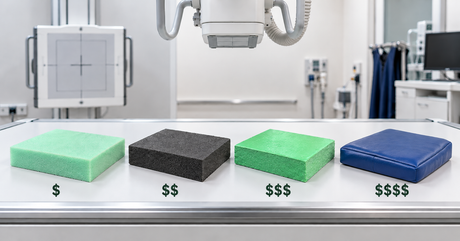
The Four Sponge Types
Oct 12th 2026
Techno-Aide manufactures positioning sponges in four distinct material configurations. They all serve the same fundamental purpose but they differ significantly in construction, infection control properties, durability, radiolucency, and cost. Understanding what each type is, and isn't, helps you choose the right sponge for each clinical environment.
Type 1: Non-Coated (Open-Cell Foam)
Non-coated sponges are the basic building block. A piece of open-cell foam cut to a specific positioning shape with no covering or coating applied. Open-cell foam has interconnected cells that allow air, and unfortunately liquids, to pass freely through the material.
Radiolucency: Highly radiolucent. Clean imaging with minimal to no artifacts.
Cleanability: No cleanable surface. The open-cell structure absorbs blood, barium, Betadine, body fluids, and cleaning solutions. Once absorbed, those fluids are nearly impossible to fully remove.
Durability: The least durable option. The exposed foam surface degrades with handling and compresses over time.
Infection control: Poor. The porous structure becomes a reservoir for bacteria, mold, and fungal growth. This is the fundamental limitation of non-coated sponges.
Cost: Least expensive option. The low unit cost makes non-coated sponges appropriate for single-use or limited-use applications where they can be disposed of regularly.
Stealth option: Some non-coated shapes are available in Stealth design, which provide proprietary flared angles that reduce the chance of artifacts.
Type 2: Coated (Open-Cell Foam + Sprayed Coating)
Coated sponges start with the same open-cell foam core as non-coated sponges, then add a proprietary medical-grade sprayed-on coating. This green-exterior coating creates a non-porous, cleanable surface over the foam.
Radiolucency: Semi-radiolucent. The coating can be visible on imaging depending on technique factors, though it's typically subtle.
Cleanability: Cleanable surface. The coating creates a wipeable barrier that prevents fluid absorption into the foam core.
Durability: More durable than non-coated foam. The coating protects the foam surface from direct contact and handling wear.
Infection control: Significantly improved over non-coated. The non-porous coating prevents fluid penetration, though the coating can develop wear spots over time that compromise the seal.
Cost: Second most expensive option on average.
Stealth option: Some coated shapes are available in Stealth design for reduced artifact visibility.
Type 3: Vinyl Covered (Open-Cell Foam + Sewn Vinyl Cover)
Vinyl covered sponges encase the open-cell foam core in a completely sewn and sealed heavy-gauge vinyl cover. This is a fundamentally different construction from the sprayed coating as it's a separate vinyl shell that envelops the foam.
Radiolucency: Semi-radiolucent, but the sewn seams are visible during most imaging. This is the key tradeoff of vinyl covered sponges.
Cleanability: Excellent cleanable surface. Vinyl is fully wipeable and resistant to all standard hospital disinfectants.
Durability: Extreme durability. The vinyl cover protects the foam from physical contact entirely. These are the tanks of the sponge world that are built for high-abuse environments.
Infection control: Excellent. Completely sewn and sealed seams create a totally non-porous surface preventing liquid absorption and cross-contamination.
Cost: Most expensive option on average.
Stealth option: Not available in Stealth design (the vinyl seams inherently create visible lines on imaging).
Type 4: Closed Cell (Cross-Link Polyethylene Foam)
Closed-cell sponges are made from an entirely different material, high-density cross-link polyethylene foam. Unlike open-cell foam, where cells are interconnected and porous, closed-cell foam consists of sealed, self-contained cells with no interconnecting channels. The material is inherently non-porous so liquid cannot penetrate it.
Radiolucency: Highly radiolucent. Artifact-free imaging. The material itself produces no visible artifacts which means no coating lines, no seam lines, nothing.
Cleanability: Fully cleanable. The non-porous surface wipes clean with any standard disinfectant.
Durability: High durability. The dense, cross-linked foam structure resists compression, tearing, and degradation.
Infection control: Excellent. The closed-cell structure is entirely resistant to fluids and liquids. No coating or cover required since the material itself is the barrier.
Cost: Second most inexpensive option, less than coated or vinyl and comparable to non-coated on average.
Stealth option: Not necessary. The material is inherently artifact-free without design modifications.
The Bottom Line
Closed-cell foam has emerged as the sponge technology that checks the most boxes with its artifact-free imaging, inherent fluid resistance, excellent durability, and competitive pricing. Techno-Aide calls closed-cell sponges 'the future of positioning aids,' and the data supports that position. They deliver the imaging quality of non-coated foam with the infection control of vinyl, at a price point between the two.
That said, each type has its role. Non-coated for disposable/limited-use applications. Coated for departments that prefer the traditional foam feel with added cleanability. Vinyl covered for extreme-durability environments where imaging artifacts from seams are acceptable. And closed cell for departments that want the best all-around performance.