
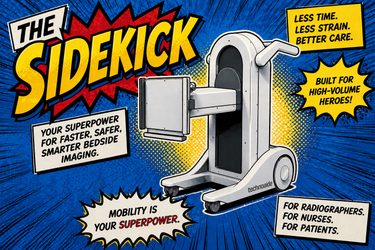
The Sidekick: Why it Changes Everything
Apr 30th 2026
Mobile radiography has a workflow problem that every technologist knows but rarely talks about. When positioning a DR panel at bedside, the process is almost entirely manual particularly for cross-table laterals, decubitus views, or any exam that requires precise panel placement. You’re reaching across patients, adjusting knobs, tightening clamps, and making fine corrections by feel rather than by control. It’s slow, it’s physically awkward, and it puts you directly in the patient’s personal space for longer than either of you would like.
Techno-Aide built the Sidekick to eliminate that problem entirely. It is the first and only fully motorized mobile DR panel positioner on the market. Once you understand what that means in practice, it’s hard to look at traditional manual holders the same way.
What the Sidekick Actually Does
At its core, the Sidekick is a mobile DR panel positioning system where every axis of motion is actuator-driven and controlled via wireless remote. Vertical travel, horizontal travel, panel tilt, and panel pivot are all powered. The technologist holds a remote, either wireless or corded depending on preference, and positions the panel with precision from a comfortable distance.
That’s worth restating, because nothing else on the market works this way. Every competing mobile panel holder requires manual adjustment on every axis. The Sidekick is the only product that lets you drive the panel into position with the press of a button.
Key capabilities include:
Wireless remote-controlled motion. All positioning is done from the remote. No reaching across the patient, no awkward angles, no lost time wrestling with manual locks.
Actuator-driven vertical and horizontal travel. Powered movement on both primary axes means smooth, repeatable positioning without the physical effort of loosening, sliding, and re-locking clamps.
Actuator-driven tilt and pivot. Panel angle adjustments that are critical for lateral and oblique views are motorized and controllable in real time rather than set-and-hope manual tilts.
Coarse and fine adjustment settings. Move quickly to approximate position, then switch to fine mode for precise placement. This dual-speed approach is only possible with powered actuation.
Ergonomic panel loading and unloading. The panel holder is designed for fast, secure loading without fumbling.
Sanitizer and disinfectant resistant surface. Designed for the infection control realities of modern imaging environments.
Locking casters. Stable positioning on any floor surface once the unit is in place.
What Exists on the Market Today—and Why It’s All Manual
To understand why the Sidekick represents a genuine category shift, it helps to look at what technologists have been working with. The mobile DR panel holder market has been dominated by manual positioning systems which use locking pins, friction clamps, and hand-tightened knobs to achieve panel placement.
Other manufacturers follow essentially the same design template: an H-base or T-base on casters, a vertical column with locking height positions, and a manual tilt-and-rotate head. The differences between them are largely cosmetic or involve minor variations in clamping mechanisms and weight capacity.
None of them are motorized. None offer remote control. Every adjustment on every axis requires the technologist to be standing next to the device, physically manipulating clamps and knobs. Techno-Aide has their own version of this. We’re just the only ones that didn’t stop there.
Where the Difference Shows Up in Practice
On paper, “manual vs. motorized” might sound like a convenience feature. In practice, the gap between the two approaches shows up in three areas that directly affect department operations.
Workflow Speed
With a manual holder, positioning a panel for a cross-table lateral involves:
- wheeling the unit into position
- loosening the vertical lock
- raising or lowering the column to approximate height
- re-locking
- loosening the horizontal clamp
- adjusting horizontal position
- re-locking
- loosening the tilt mechanism
- angling the panel
- re-locking
- then stepping back to see if everything is aligned before potentially repeating several of those steps.
That's a lot of steps. Each lock-adjust-relock cycle takes time, and the cumulative effect across a busy portable shift adds up.
With the Sidekick, the same positioning sequence is:
- wheel into approximate position
- pick up the remote
- drive the panel to exact position using coarse and fine modes.
That's much easeier! There is no lock-adjust-relock cycle because actuator-driven motion holds position by the default. What takes multiple manual adjustments collapses into a single continuous remote-guided motion.
Patient Experience
Mobile imaging already puts patients in a vulnerable position. They’re typically in bed, often uncomfortable, and the arrival of portable x-ray equipment can be stressful. Manual panel positioning requires the technologist to reach into the patient’s space repeatedly, adjusting hardware around and sometimes over the patient. The closer and longer the tech must work in the patient’s personal space, the more uncomfortable the experience becomes.
The Sidekick’s remote-controlled operation means the technologist can position the panel from several feet away. The panel moves into position smoothly and predictably. The patient interaction is shorter and less intrusive.
Ergonomic Load on Technologists
Repetitive manual adjustment of panel holders, particularly the overhead reaching, grip-and-twist motions required for vertical and tilt adjustments, is an ergonomic concern that gets worse over the course of a long shift. Technologists who run high-volume portable routes deal with these motions dozens of times per day. Powered actuation eliminates the physical strain of those adjustments entirely.
Comparing the Sidekick to Manual Alternatives
The comparison below puts the Sidekick alongside the most common manual panel holder on the market to illustrate the functional differences:
|
Feature |
Sidekick (Techno-Aide) |
Typical Manual Holder |
|
Vertical Travel |
Powered actuator, wireless remote |
Manual, 26 locking positions |
|
Horizontal Travel |
Powered actuator, wireless remote |
Manual clamp, hand-adjusted |
|
Panel Tilt |
Powered actuator, wireless remote |
Manual, friction lock |
|
Panel Pivot |
Powered actuator, wireless remote |
Manual rotation |
|
Adjustment Precision |
Coarse and fine modes |
Single manual adjustment |
|
Control Method |
Wireless or corded remote |
Direct manual contact |
|
Disinfectant Resistant |
Yes |
Varies by model |
|
Made in USA |
Yes — Nashville, TN |
Varies |
Who the Sidekick Is Built For
The Sidekick is designed for imaging departments where portable radiography is a significant part of daily operations. High-volume hospitals, trauma centers, ICUs, and facilities that run dedicated portable routes are the environments where the time savings and ergonomic advantages compound the fastest.
It’s also a strong fit for departments that prioritize patient experience metrics. Reducing the time and physical intrusiveness of bedside imaging is a tangible improvement that patients notice and staff appreciate.
At $15,000, the Sidekick is a higher investment than manual alternatives in the $1,900–$2,300 range. That price reflects the engineering required to build actuator-driven motion on all four axes with wireless control into a mobile, hospital-grade platform. For departments evaluating the purchase, the relevant question is whether the workflow time savings, reduced reshoots, improved patient experience, and lower ergonomic burden on staff justify the investment over the life of the equipment. For high-volume portable operations, the math tends to work.
Made in Nashville, Built for the Imaging Department
The Sidekick is manufactured by Techno-Aide at our facility in Whites Creek, Tennessee, just outside Nashville, where we’ve been building radiation protection and imaging accessories for more than 45 years. It reflects the same design philosophy behind everything we make: identify a real problem that technologists deal with every day and engineer a solution that works in a clinical environment.
There was nothing motorized in the mobile panel holder category before the Sidekick. Every product on the market was manual. We believed that technologists deserved better than locking pins and friction clamps, so we built the product to prove it.