
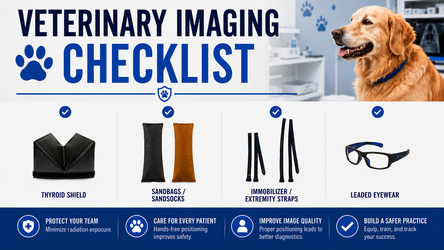
Veterinary Imaging Checklist
Jul 1st 2026
In human radiology, it's been decades since staff routinely held patients in position during x-ray exposures. The practice is universally recognized as unnecessary and unsafe so technologists use positioning sponges, sandbags, immobilization devices, and communication with the patient to achieve proper positioning without putting their hands in or near the radiation field.
In veterinary radiology, the transition to hands-free positioning has been slower. A 2025 study in the Journal of the American Veterinary Medical Association found significant underuse of hands-free techniques in small animal veterinary medicine, with veterinary professionals frequently holding animals during radiographic exposures placing their hands and bodies in the scatter radiation field for every image.
This doesn't have to be the case. The same principles and many of the same positioning tools used in human radiology apply directly to veterinary imaging.
The Radiation Risk in Veterinary Practice
The American College of Veterinary Radiology (ACVR) emphasizes that personnel should not be in the primary radiation beam during exposures and should always wear appropriate personal protective equipment when scatter exposure is unavoidable.
When a veterinary technician manually restrains an animal during radiography, they receive scatter radiation exposure with every image. Over a career that might span 20 to 30 years and thousands of exposures, cumulative dose becomes a serious occupational health consideration. The biological effects of ionizing radiation don't distinguish between human and veterinary healthcare settings.
Hands-free radiography utilizes positioning techniques that eliminate the need for personnel to hold patients during exposures. This removes the primary source of occupational radiation exposure in the veterinary radiology environment.
Positioning Aids for Veterinary Imaging
Many of the positioning tools used in human radiology are directly applicable to veterinary imaging, with some adaptations for the different body geometries and cooperation levels of animal patients.
Sandbags and Sandsocks
Sandbags are the workhorse of hands-free veterinary positioning. Placed alongside or on top of a sedated or cooperative animal, they provide the gentle weight needed to maintain positioning without manual restraint. Flexible sandsocks are particularly useful in veterinary imaging because they conform to the irregular contours of animal limbs and torsos.
A well-stocked veterinary radiology room should have sandbags in multiple weights. Lighter options for cats, small dogs, and exotics, and heavier bags for medium and large dogs. Techno-Aide's sandbag range covers this spectrum, with vinyl-covered construction that handles the cleaning demands of a busy veterinary practice.
Foam Positioning Sponges
Radiolucent foam wedges and blocks serve the same purpose in veterinary radiography as they do in human imaging: they position the anatomy at the correct angle relative to the x-ray beam and image receptor. Wedge sponges under or alongside the thorax position a dog for a lateral view. Rectangular blocks elevate a limb to center it in the beam. V-shaped sponges cradle the animal in a ventrodorsal position.
Proper positioning is critical in veterinary imaging because it directly affects diagnostic quality. Improper positioning for radiographic examination can result in misdiagnosis or the inability to appreciate major lesions just as in human radiology. The difference is that you can't ask the patient to cooperate.
Tape and Immobilization Accessories
Immobilizer and extremity straps supplement sandbags and sponges for animals that need additional stabilization. These accessories help maintain limb positions during extremity radiography and can position the head and neck for skull and cervical studies. Combined with appropriate sedation these tools make true hands-free radiography achievable for most veterinary imaging studies.
PPE When Hands-Free Isn't Possible
There are clinical situations where some degree of manual positioning assistance is unavoidable such as fractious patients, emergency situations, or specific positioning requirements that available aids can't fully achieve. In these situations, comprehensive personal protective equipment is mandatory: lead apron, thyroid collar, leaded gloves, and leaded eyewear. Personnel should maximize their distance from the primary beam and never place any body part in the primary radiation field.
Techno-Aide manufactures the complete range of PPE used in veterinary settings, including lightweight lead aprons that reduce fatigue during busy clinic days, thyroid shields, and leaded gloves designed for the dexterity needed in animal handling.
Building a Hands-Free Program
Transitioning a veterinary practice from manual restraint to hands-free radiography is a training and equipment investment that pays dividends in staff safety and image quality. Start by equipping each imaging room with an appropriate assortment of sandbags, sponges, and immobilization accessories. Train staff on positioning techniques that use these aids effectively. Track your hands-in-field rate and celebrate improvements.
Techno-Aide's veterinary positioning aids and radiation protection equipment are manufactured with the same quality standards as our human radiology products. Our team can help veterinary practices build a hands-free positioning program matched to their practice volume and patient mix.