
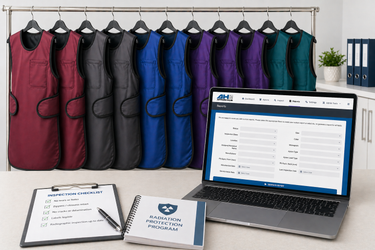
Building a Radiation Protection Inventory Program
Apr 29th 2026
Without a system for tracking what you have, where it is, what condition it’s in, and when it needs to be replaced, even the best inspection protocol has gaps. This post provides a practical, step-by-step framework for building or upgrading a radiation protection inventory program that stands up to regulatory scrutiny and actually improves safety.
Step 1: Conduct a Full Inventory Audit
Before you can manage your garment fleet, you need to know exactly what you have. This sounds obvious, but many facilities discover during their first comprehensive audit that protective garments have migrated between departments, been stashed in storage closets, or simply gone missing.
For every garment in the facility, record a unique identifier (sequential number or barcode), garment type and style (front apron, vest, skirt, thyroid shield, etc.), core material (lead, composite, Bilayer lead-free), rated Pb equivalence (0.25 mm, 0.35 mm, 0.5 mm), manufacturer and model, date of purchase or estimated age, assigned department or room, and current condition based on visual inspection.
Step 2: Establish Inspection Schedules and Assign Responsibility
Every garment in the inventory needs to be on an inspection cycle. The industry standard is annual radiographic inspection for all garments, with immediate inspection following any visible damage event such as a dropped garment or a torn closure.
Assign clear responsibility. In some facilities, the Radiation Safety Officer (RSO) manages inspections directly. In others, a lead technologist or department supervisor takes ownership. Larger health systems may outsource inspection to specialized services that bring mobile X-ray equipment and perform on-site scanning. The method matters less than the clarity of accountability. Someone specific must own the process.
Step 3: Implement Digital Tracking
Paper logs work in small facilities with a handful of garments, but they don’t scale. A digital tracking system, whether a dedicated garment management platform, a module within your broader radiation safety software, or even a well-structured spreadsheet, provides several critical capabilities: a searchable database of all garments and their current status, automated alerts for upcoming inspections, historical records of every inspection result for each garment, and location tracking to prevent garment loss between departments.
Barcode or RFID tagging makes digital tracking practical at scale. A barcode sticker on each garment allows quick scanning during audits and inspections, linking the physical garment to its digital record instantly.
Step 4: Set Replacement Criteria and Budget
Garments don’t last forever, and planning for replacement is cheaper than reacting to failures. Establish replacement criteria based on your historical data: the average age at which garments fail inspection in your facility, the typical failure mode (cracking, delamination, material migration), and the garment types that fail most frequently.
For budgeting purposes, most facilities should expect to replace 10–20% of their garment inventory annually, depending on use intensity and garment quality. Higher-quality garments from domestic manufacturers like Techno-Aide tend to have longer service lives, which reduces the annual replacement rate and total cost of ownership over time.
Step 5: Standardize on a Single Vendor
This is the step that many facilities overlook, and it’s the one that simplifies everything else. When your protective apparel comes from a single manufacturer, you get consistent protection levels across all garments (no guessing about whether Department A’s aprons match Department B’s standards), simplified procurement with a single point of contact, unified sizing systems that make it easy to order replacements, streamlined warranty and service terms, and a single set of care and maintenance guidelines.
Techno-Aide’s breadth of product line makes single-vendor standardization practical. From aprons and vests to thyroid shields, glasses, and mobile barriers, plus the complete positioning sponge catalog, one vendor can cover the full radiation protection and patient positioning spectrum.
The Payoff: Compliance Confidence
A well-run inventory program does more than keep garments tracked. It gives your facility defensible documentation of a systematic approach to radiation protection. When the Joint Commission surveyor asks about your protective equipment program, or when a state inspector reviews your radiation safety documentation, having a complete digital trail of every garment’s lifecycle, from procurement through inspection to retirement, demonstrates exactly the kind of proactive safety culture that regulators want to see.