
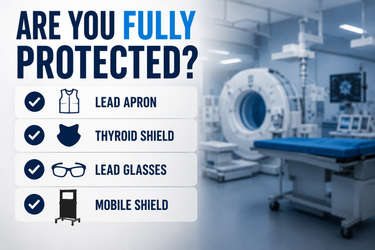
Complete Head-to-Toe Protection
Jun 18th 2026
Most radiation protection conversations start and end with the apron. Rightfully so, since the torso houses the body’s most critical organs, and covering it is the single highest-impact shielding decision. Limiting the conversation to aprons, however, is like discussing fire safety and only talking about extinguishers. A comprehensive radiation protection program accounts for every vulnerable anatomical structure, and several of the most radiation-sensitive areas aren’t covered by any apron.
Thyroid Shields: No Longer Optional
The thyroid gland is one of the most radiosensitive organs in the body, and it sits completely outside the coverage area of even the most generous apron. Thyroid shields have long been recommended in fluoroscopy environments, but the latest dose limit revisions have made them essential.
Techno-Aide offers thyroid shields in 0.5 mm and 0.35 mm Pb equivalent front protection, available in all three core material options: traditional lead, lightweight composite, and Bilayer lead-free. The choice between full-binding and no-binding styles allows departments to standardize on the closure type their staff prefers, which in turn improves consistent wear.
Lead Glasses: The New Mandate
The most significant radiation protection policy change in recent years has been the ICRP’s reduction of the annual eye lens dose limit from 150 mSv to 20 mSv. This tenfold reduction was driven by compelling evidence that scatter radiation causes posterior subcapsular cataracts in interventional staff at doses well below the previous threshold.
For interventional radiologists and cardiologists, this revised limit is nearly impossible to meet without protective eyewear. Lead glasses with side shields are now considered standard equipment in any environment with regular fluoroscopy use. Techno-Aide’s eyewear line includes multiple frame styles from wraparound sport designs to professional frames from recognizable brands because eyewear that doesn’t fit well or look acceptable won’t get worn.
Specialty Protection for Specific Clinical Scenarios
Beyond the core apron, thyroid, and eye protection, several clinical scenarios demand specialized shielding:
Pregnancy lap guards: Provide additional abdominal shielding for pregnant staff or patients. Techno-Aide’s pregnancy lap guard is designed to sit comfortably over an apron, adding targeted protection over the uterus without requiring a complete apparel change.
Pediatric drapes: Smaller, lighter shielding designed for pediatric patients who cannot tolerate full adult-sized protective equipment.
Radiation sleeves: For interventional staff whose are frequently in or near the primary beam field.
Mobile Shields: Room-Level Protection
Techno-Aide’s Standard T-Base Mobile Radiation Shields provide a movable barrier between the radiation source and staff, particularly useful in rooms where ceiling-mounted shields aren’t available or for procedures where staff positioning varies.
The key to effective mobile shield use is positioning. The shield should be placed between the scatter source (the patient) and the staff member, as close to the source as practical. Even a modest mobile shield can reduce scatter dose to unshielded areas by 80–90% when properly positioned.
The One-Stop-Shop Advantage
There’s a practical procurement argument for sourcing your complete protection program from a single manufacturer. When aprons, thyroid shields, glasses, and accessories all come from Techno-Aide, you get consistent Pb equivalence ratings across products, simplified ordering and inventory management, unified warranty and service terms, and the assurance that every component has been tested to the same rigorous standards.
Radiation protection isn’t a single product but rather a system and systems work best when the components are designed, manufactured, and validated together.