
Deeper Dive into kV Levels
Jun 3rd 2026
All radiation protection is not created equal. The apron hanging in your fluoroscopy suite does not provide the same level of protection regardless of the procedure. The truth is that the effectiveness of any radiation shielding material is directly tied to the energy of the X-ray beam it’s trying to attenuate. That energy is controlled by the tube voltage, measured in kilovolts (kV).
What kV Actually Controls
The kV setting on an X-ray tube determines the maximum energy of the photons in the beam. Higher kV means higher-energy photons, which penetrate tissue more easily. This is why kV selection is one of the most fundamental technical decisions in radiographic imaging. It directly affects image contrast, patient dose, and the penetrating power of both the primary beam and the resulting scatter radiation.
Here’s the practical range most clinical staff encounter daily:
Diagnostic radiography: 60–80 kV for most extremity and chest work, with some techniques pushing to 120 kV for lateral spine or bariatric patients.
Fluoroscopy: 65–70 kV is typical for interventional procedures, though automatic brightness control can push this higher during challenging anatomy.
CT fluoroscopy: 120–140 kV, with 120 kV being the most common default setting.
The gap between a standard fluoroscopy case at 65 kV and a CT-guided biopsy at 120 kV is enormous in terms of what it demands from your protective apparel.
Why the Same Apron Performs Differently at Different kV
Radiation shielding works by absorbing or deflecting photons before they reach the wearer. The efficiency of this process depends on the relationship between the photon energy and the atomic properties of the shielding material. Lead, for example, is exceptionally effective at attenuating lower-energy photons because of the photoelectric effect. Incoming photons are absorbed completely by lead’s dense electron cloud.
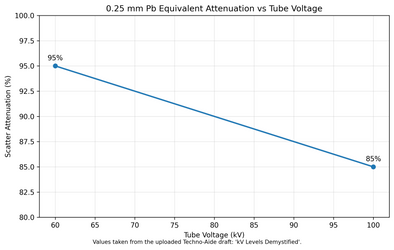
As kV increases, a larger proportion of photons carry enough energy to pass through or scatter within the shielding material rather than being absorbed. The practical result is this: a lead apron rated at 0.25 mm Pb equivalent that blocks 95%+ of scatter at 60 kV may only block 85% at 100 kV. That 10% difference translates directly to increased dose to the wearer’s body.
This is why most radiation safety guidelines recommend a minimum of 0.35 mm Pb equivalent for routine fluoroscopy and 0.5 mm Pb equivalent for high-dose interventional procedures. The recommendation is calibrated to the kV ranges those procedures use.
The Testing Problem: One kV Doesn’t Tell the Whole Story
Here’s where things get concerning from a purchasing perspective. Many radiation protection products are often tested at a single favorable kV that makes the attenuation numbers look their best. A manufacturer might report that their material provides 0.5 mm Pb equivalent attenuation at 80 kV, but what happens at 100 kV? At 120 kV? Without testing across the clinical range, there’s no way to know.
This is precisely why the IEC 61331-1:2014 standard matters. Unlike older or narrower test protocols, IEC 61331-1:2014 evaluates protective materials across a range of beam qualities that simulate real clinical conditions including, critically, the secondary (fluorescent) radiation that reaches the wearer from scatter. It’s the only international standard that explicitly tests for this, and it’s the reason some materials that perform well on paper fail in practice.
What This Means for Your Facility
If your facility performs a mix of procedures at different kV levels then you need protection that has been validated across that range. A few practical steps:
- Know your kV range. Talk to your physicists or check your fluoroscopy unit’s typical operating parameters. If you’re routinely above 80 kV, ensure your apparel is rated for it.
- Ask for multi-energy test data. When evaluating new apparel, request attenuation data at multiple kV values, not just one.
- Look for IEC 61331-1:2014 certification. This is the gold standard for broad-spectrum testing, including scatter.
- Don’t assume lightweight means less protection. Modern composite and bilayer materials can achieve the same Pb equivalence at significantly less weight. The key is whether they’ve been properly tested at clinical energies.