
Dental Radiation Protection Checklist
May 12th 2026
Dental imaging is one of the most common uses of diagnostic x-rays in healthcare. Between bitewing series, periapical films, panoramic images, and the growing use of cone beam computed tomography (CBCT), dental practices expose more patients to ionizing radiation per year than many hospital radiology departments. The doses are small, but the sheer volume means radiation protection deserves serious attention.
Why Dental Radiation Protection Matters
Individual dental x-ray doses are low. A standard intraoral radiograph delivers roughly 5-10 microSieverts (µSv), and a panoramic image approximately 10-25 µSv. For comparison, a chest x-ray delivers about 20 µSv. However, a full-mouth series of 18-20 films adds up, and CBCT scans can deliver 50-500 µSv depending on the field of view.
The cumulative nature of radiation exposure is what makes protection important. Most dental patients return annually or biannually, and the radiation protection measures your practice uses communicate professionalism and care to every patient who sits in the chair.
Patient Shielding in Dental Settings
Lead Aprons for Dental Patients
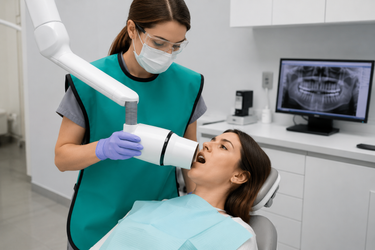
Patient lead aprons remain the most visible form of radiation protection in dentistry. A standard dental patient apron covers the torso from the shoulders to the mid-thigh, shielding the chest, abdomen, and reproductive organs from scatter radiation.
For dental use, lightweight aprons in the 0.25mm Pb equivalent range provide adequate protection given the low kVp settings used (typically 60-70 kVp for intraoral radiography). Heavier aprons designed for fluoroscopy are unnecessary and create patient discomfort that can lead to movement artifacts.
Thyroid Collars: Essential for Dental Imaging
The thyroid gland sits directly in or near the primary beam path for many dental projections, particularly periapical views of maxillary teeth and panoramic radiographs. This makes thyroid collars arguably more important in dental imaging than in most other radiographic applications.
The American Thyroid Association has noted the potential link between repeated dental radiation exposure and thyroid cancer risk, particularly in children and young adults. A thyroid collar adds seconds to the positioning process and provides meaningful dose reduction to one of the body's most radiosensitive organs.
Pediatric Considerations
Children are more sensitive to radiation than adults since their cells are dividing more rapidly, and they have more years ahead in which radiation-induced effects could manifest. Pediatric dental patients should always be shielded, and practices that treat children should stock appropriately sized aprons and thyroid collars.
Techno-Aide manufactures child-sized radiation protection garments specifically for this purpose. A child wearing a properly fitted apron is both better protected and more comfortable than one draped in an oversized adult garment.
Operator Protection
Dental office staff face unique exposure considerations. In many practices, the same person positions the patient, triggers the exposure, and develops or processes the image dozens of times per day.
Distance: Operators should stand at least six feet from the x-ray source during exposure, preferably behind a structural barrier. The inverse square law means doubling your distance cuts your dose to one-quarter.
Position: Never hold the film or sensor in the patient's mouth during exposure. Position-indicating devices (PIDs) and film holders eliminate this practice entirely.
Barriers: If your operatory layout doesn't allow the operator to leave the room, a mobile radiation barrier or leaded partition provides effective protection. Even a small leaded glass or leaded acrylic panel positioned between the operator and the x-ray source significantly reduces scatter exposure.
Dosimetry: Dental staff who regularly operate x-ray equipment should wear dosimetry badges. Many state regulations require this, and it provides both baseline data and peace of mind.
CBCT: The Growing Need for Dental Radiation Management
Cone beam computed tomography has transformed dental diagnostics, providing three-dimensional imaging for implant planning, endodontic evaluation, orthodontic assessment, and oral surgery. But CBCT doses can be 5-50 times higher than a panoramic image, depending on field of view and resolution settings.
Practices using CBCT should apply the same ALARA principles used in medical imaging: use the smallest field of view that answers the clinical question, select appropriate resolution settings (standard rather than high-resolution when sufficient), and ensure patients are properly shielded for areas outside the primary beam.
Equipping Your Practice
A well-prepared dental practice should have on hand: patient lead aprons in adult and child sizes, thyroid collars that pair with those aprons, dosimetry badges for all staff operating radiographic equipment, and either structural shielding in operatory walls or mobile barriers for operator protection.
Replace aprons that show signs of wear like cracking, creasing, or thinning. Implement a regular inspection schedule (annual fluoroscopic or visual inspection) and retire garments that no longer provide reliable attenuation. Drape aprons over rounded hangers rather than folding them to extend their useful life.
Communicating Protection to Patients
Patients increasingly ask about radiation exposure during dental visits. Having clear, factual answers and demonstrating visible protection measures builds trust and differentiates your practice. "We use thyroid collars on every patient" is a simple statement that communicates a culture of care.
Techno-Aide provides radiation protection products to dental practices across the country, from single-operatory offices to multi-location dental groups. Every product is manufactured in Nashville, Tennessee, with the same quality standards we apply to our hospital-grade radiation protection equipment.