
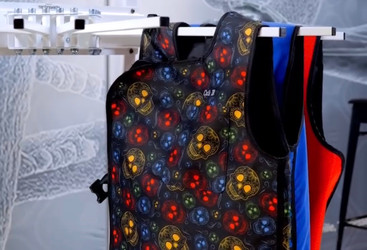
Do's & Don'ts of Hanging Lead
Oct 26th 2026
If every imaging department adopted one single practice to extend the life of their radiation protection garments, it should be to hang them properly. No amount of cleaning, inspection frequency, or even the quality of the garment itself affects longevity more than how the garment is stored between uses. A premium garment that gets folded over a chair after every use will fail before a budget garment that gets hung on a proper rack.
Here's the definitive guide on what, and what not to do when the apron comes off.
The Do’s
Do: Use a Dedicated Storage Rack
Every room that uses radiation protection garments should have a dedicated storage solution. Either a wall-mounted rack with wide, curved pegs or a floor-standing hanger tree. The key feature is wide, rounded support surfaces that distribute the garment's weight across a broad area. Wall-mounted racks with wide pegs are space-efficient and keep garments visible and accessible. Hanger trees are mobile and can be positioned wherever they're most convenient.
Do: Drape Over Wide Supports
The garment should hang over a support surface that's at least 3-4 inches wide. This prevents the sharp bending that cracks attenuating material. Think of the garment as a flexible panel that needs to maintain gentle curves, not sharp angles, everywhere along its length. Wide pegs, contoured hangers, or rounded rack arms provide this gentle support.
Do: Hang Immediately After Use
When the case is over and the garment comes off, it should go directly to the rack. Not on the counter 'for a minute.' Not on the back of a chair 'until I have time.' Not folded and set on a shelf 'because the rack is across the room.' Immediately. Every minute spent draped over a narrow surface or folded on a flat one is cumulative stress on the attenuation layer.
Do: Space Garments Adequately
Garments need air circulation between them to prevent moisture buildup and allow cleaning products to dry completely. If garments are packed tightly on a rack with no space between them, moisture and cleaning chemical residue get trapped against the fabric, accelerating degradation. Space garments at least 2-3 inches apart.
Do: Match Storage Capacity to Garment Count
A wall rack rated for 8 aprons shouldn't hold 12. Overcrowded racks force garments into compressed positions, create sharp folds at the peg contact points, and make it difficult for staff to remove or replace garments without pulling others off the rack. If you need storage for 12 garments, install rack capacity for 12 garments.
The Don'ts
Don't: Fold. Ever
Folding is the number one killer of radiation protection garments. When a garment is folded, the internal attenuating material is forced into a sharp crease. At the fold line, the material cracks. The crack is invisible externally but allows radiation to pass through. There is no acceptable reason to fold a radiation protection garment. Not for storage, not for transport, not for 'just a minute.'
Don't: Drape Over Narrow Surfaces
Chair backs, door tops, monitor arms, IV poles, and table edges are not storage solutions. They're narrow surfaces that create the same concentrated bending stress as folding. A garment draped over a chair back develops a crack line at the chair edge just as surely as one that's folded in half.
Don't: Pile on a Counter or Shelf
Multiple garments piled on a flat surface compress under their own weight. The garments at the bottom of the pile experience the most stress, and the random folds and bunching create multiple crack-initiation points. If you've ever walked into a department and seen a pile of aprons heaped on a counter, you've seen garments being destroyed in slow motion.
Don't: Store in a Closed Cabinet Without Ventilation
Closed cabinets trap moisture and cleaning chemical fumes against the garment surfaces. Over time, this accelerates vinyl degradation and can affect the attenuating material. If cabinet storage is necessary due to space constraints, ensure the cabinet has ventilation openings and that garments are hung (not folded) on wide-support hangers inside.
Don't: Ignore Load Ratings
A loaded apron rack holding 8-10 garments can weigh 100-150 pounds. Wall-mounted racks must be secured into studs or with appropriate anchors rated for the load. A rack that pulls out of the wall drops your entire garment inventory onto the floor, potentially damaging every garment in the department in a single event.
Storage Solutions from Techno-Aide
Techno-Aide manufactures wall-mounted storage racks and accessories designed specifically for radiation protection garments. Our racks feature wide, rounded support surfaces, adequate spacing between garment positions, and mounting hardware rated for the heavy loads that protective apparel represents. We build storage solutions because we know that the garments we manufacture only last as long as they're stored properly.