
Explaining Bilayer Technology
Jun 5th 2026
Scatter radiation is the primary occupational hazard for interventional staff, and most lead-free shielding materials have never been tested against it. Today, we’re going deeper into the material science behind Techno-Aide’s Bilayer, lead-free core that passes the most rigorous international protection standard, and how its engineering translates to real benefits for the people who wear it every day.
The Problem with Single-Layer Lead-Free Materials
Traditional lead shielding works because lead’s high atomic number (82) and dense electron structure make it exceptionally effective at absorbing X-ray photons through the photoelectric effect. When the industry began developing lead-free alternatives, the typical approach was to use a single composite of heavy metals such as tin, barium, or bismuth blended into a flexible polymer matrix.
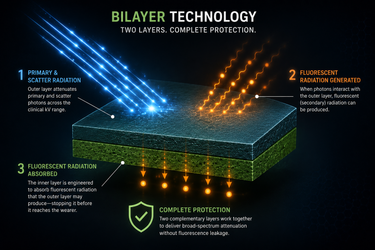
These single-layer composites can perform well against primary beam radiation at certain energies. The challenge arises from a phenomenon called K-edge fluorescence. Every element has characteristic energy levels at which its atoms absorb photons particularly well—and then re-emit lower-energy fluorescent photons. When the X-ray beam’s energy is near the K-edge of the elements in a single-layer material, the material can generate secondary fluorescent radiation that passes through to the wearer.
This is exactly what IEC 61331-1:2014 tests for and exactly why many single-layer lead-free materials fail it.
How Bilayer Solves the Fluorescence Problem
Techno-Aide’s Bilayer takes a fundamentally different approach. Instead of relying on a single composite layer, Bilayer uses two distinct attenuating layers, each with a different elemental composition optimized for a different portion of the X-ray energy spectrum.
The outer layer facing the radiation source is designed to attenuate the primary and scatter photons across the clinical kV range. The inner layer closest to the wearer is specifically engineered to absorb the fluorescent radiation that the outer layer may produce. Together, the two layers create a complementary system where each layer compensates for the other’s limitations.
The result is broad-spectrum attenuation that performs consistently from low-energy diagnostic work through high-kV interventional procedures without the fluorescence leakage that compromises single-layer alternatives.
Lighter Without Compromise
One of the most immediately noticeable benefits of Bilayer is weight. Compared to traditional lead at equivalent protection levels, Bilayer garments are 16–40% lighter. For a vest-and-skirt combination worn during a four-hour interventional case, that weight reduction can mean the difference between two and three pounds off the wearer’s shoulders and hips.
This is a clinical safety issue. Research on musculoskeletal injury among interventional staff has documented alarming rates of chronic back pain, cervical disc disease, and rotator cuff injuries directly attributable to years of wearing heavy protective apparel. Lighter garments don’t just feel better; they reduce the cumulative orthopedic burden that drives staff out of interventional specialties.
Perhaps more importantly, lighter apparel improves compliance. When protection is heavy and uncomfortable, staff are more likely to skip it during short cases, wear it improperly, or remove it during breaks in long procedures. Every moment of non-compliance is unshielded scatter exposure. By making protection lighter, Bilayer helps ensure it gets worn.
Three Certifications, Three Different Tests
Bilayer passes all three major international standards, each testing a different aspect of performance:
IEC 61331-1:2014 tests total radiation reaching the wearer, including fluorescent and scatter radiation. This is the standard that most lead-free materials fail.
DIN 6857-1 characterizes the material’s lead-equivalent thickness and attenuation properties.
ASTM F2547-06 measures primary beam attenuation at specified beam qualities.
All testing was conducted independently at the UK’s National Physical Laboratory, not by Techno-Aide, not by a vendor-affiliated lab, but by one of the world’s most respected metrological institutions. This independence matters because it removes any question of testing bias.
Available Across the Full Product Line
Bilayer isn’t limited to a single product. Techno-Aide offers the Bilayer core across its complete apparel catalog:
- Front aprons (standard, comfort-flex, and surgical styles)
- Full wrap and contour vests paired with full wrap skirts
- Thyroid shields in 0.5 mm and 0.35 mm Pb equivalent
- Specialty protection including lap guards, pregnancy guards, and dental drapes
Every product is manufactured in Techno-Aide’s Nashville, Tennessee facility, which means tighter quality control, faster lead times, and the ability to fulfill custom sizing and configuration requests without the delays inherent in overseas manufacturing.
The Takeaway
Bilayer represents a genuine advancement in radiation protection material science because it’s lead-free, significantly lighter, and has been independently proven to protect against the full spectrum of radiation that clinical staff face. When you combine broad-spectrum attenuation, reduced weight, and triple certification, the case for Bilayer becomes extremely compelling.