
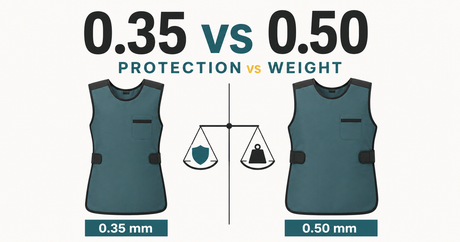
How to Choose Between 0.35mm or 0.50mm Protection
Aug 31st 2026
One of the first decisions when ordering radiation protection apparel is the Pb equivalency: 0.35mm or 0.50mm. It seems like a simple more-is-better choice, so why not always go with the higher protection? The decision involves a real tradeoff between attenuation and weight, and the right answer depends on your clinical environment, exposure patterns, and how long staff wear the garment per shift.
What the Numbers Mean
Lead equivalency (Pb equivalency) describes how much radiation a material attenuates, expressed as the thickness of pure lead that would provide the same attenuation. A garment rated at 0.50mm Pb blocks the same amount of radiation as a solid sheet of lead 0.50mm thick. A 0.35mm Pb garment blocks the same amount as 0.35mm of lead.
At 100 kVp, a standard testing energy for diagnostic x-ray conditions, Techno-Aide's core media data shows clear differences in attenuation performance. At 0.35mm Pb equivalency, attenuation is approximately 95.5%, meaning about 4.5% of incident radiation is transmitted through the garment. At 0.50mm Pb equivalency, attenuation rises to approximately 97.9%, reducing transmission to about 2.1%.
That 4.5% transmission to 2.1% difference means a 0.50mm garment blocks roughly half the residual radiation that gets through a 0.35mm garment. In absolute terms, both levels provide excellent protection from scatter radiation but the relative improvement from 0.35 to 0.50 is significant for staff with high cumulative exposure.
The Weight Tradeoff
Higher attenuation requires more attenuating material, and more material means more weight. A 0.50mm garment of the same style and size is noticeably heavier than a 0.35mm garment. The difference varies by media type (Regular Lead, Lightweight Lead, or Lead-Free Bilayer), but as a practical guide, stepping from 0.35mm to 0.50mm in the same garment style adds roughly 20-30% more weight.
That additional weight accumulates over a shift. For a technologist who puts on an apron for a five-minute portable exam and takes it off, the difference is negligible. For an interventional cardiologist who wears a vest-skirt system for a four-hour case, the additional weight translates to meaningful additional strain on the shoulders, back, and hips.
When 0.50mm Makes Sense
The higher protection level is most justified in environments with higher scatter radiation levels and longer exposure times:
Cardiac catheterization labs: High-volume fluoroscopy with extended procedure times. Staff are close to the scatter source for extended periods. The additional attenuation is warranted.
Interventional radiology suites: Complex procedures with significant fluoroscopy time. Primary operators and close-support staff benefit from 0.50mm protection.
Front protection on wrap garments: On full-wrap aprons and vest-skirt systems, the front panel faces the scatter source directly. Techno-Aide's full wrap designs commonly use 0.50mm front / 0.25mm back configurations for maximum protection where the exposure is highest, reduced weight where the exposure is lower.
When 0.35mm Is Sufficient
Lower exposure environments and shorter wearing times make 0.35mm a practical and responsible choice:
General radiography: Technologists wearing front aprons during portable exams experience low scatter levels for short durations. 0.35mm provides excellent protection without unnecessary weight.
Back panels of wrap garments: The back of a wrap garment receives significantly less scatter radiation than the front. Using 0.35mm Pb front and 0.175mm Pb back on a full wrap garment (or 0.50mm front / 0.25mm back) is a common and well-reasoned configuration.
Infrequent users: Staff who wear protective apparel intermittently, like nurses who step in for an occasional fluoroscopy case or administrators who observe procedures periodically, receive limited cumulative exposure where 0.35mm provides ample protection.
Same Style, Both Options
Every Techno-Aide garment style is available in both 0.35mm and 0.50mm Pb equivalency. This means a department can standardize on a single garment style and provide 0.50mm to high-exposure staff (interventionalists, primary operators) and 0.35mm to lower-exposure staff (circulating nurses, occasional users). Same look, same storage, different protection levels based on individual need.
Techno-Aide can help you evaluate your department's exposure patterns and recommend the right protection level for each role. The goal is appropriate protection for every scenario, not just maximum protection for everyone regardless of need.