
How to Store and Maintain Lead Aprons to Maximize Lifespan
Apr 20th 2026
Lead aprons represent a significant investment in your facility's radiation protection program. Yet improper storage routinely destroys that investment. A single cracked apron that fails fluoroscopic inspection becomes a compliance liability and an unplanned replacement cost. The good news: proper storage practices are straightforward, and they pay for themselves by extending apron lifespan by years.
Why Proper Storage Is a Cost Protection Strategy
Lead aprons are engineered to absorb radiation, but their internal lead layer is fragile. When stored incorrectly, aprons degrade invisibly. Cracks develop inside the lead core long before they're visible on the outer fabric.
A replacement lead apron typically lasts five to ten years if stored properly, compared to just one to three years for aprons subjected to improper storage. That's a 5-10x difference in cost per year of protection. For a department managing ten aprons, the difference can amount to tens of thousands of dollars over a decade.
The Folding Problem: Why Creases Become Cracks
This is the single most damaging mistake in lead apron handling: folding.
When you fold a lead apron, the weight of the apron itself creates sharp creases in the internal lead layer. These bends form stress points where the lead begins to crack. Over weeks or months, internal cracks grow and eventually trigger automatic rejection at fluoroscopic inspection.
The solution is equally simple: never fold lead aprons. During storage, hanging is non-negotiable. When transporting, roll them gently around a cardboard tube or lay them completely flat.
Wall-Mounted Racks: Fixed Storage for High-Traffic Areas
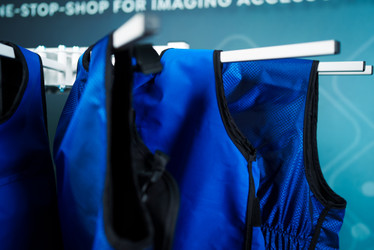
Wall-mounted swing-arm racks are the standard solution for departments where aprons are accessed multiple times daily such as imaging centers, surgery suites, catheterization labs, and interventional radiology rooms.
- Space-efficient: aprons hang vertically on swing arms that fold flat against the wall when not in use
- Quick access: multiple aprons stored and ready at the point of use
- Proper hanging: heavy-duty hangers support the apron's weight across both shoulders
- Visibility: staff can immediately see available aprons and their condition
Install racks directly inside the rooms where aprons are used most frequently. This eliminates the need to transport aprons between storage and work areas, reducing handling and damage.
Mobile Racks: Flexible Storage for Multi-Room Departments
When aprons must be shared across multiple rooms or when wall space is unavailable, mobile free-standing swing-arm racks are the better choice.
- Portability: transport aprons on locking casters directly from storage to the room
- Higher capacity: mobile racks typically hold eight to ten aprons vs. five to seven on wall-mounted units
- Flexible deployment: move aprons to high-demand areas as workflow patterns shift
- Better inventory management: easier to account for all aprons in the department
Transportation and Carrying Bags
- Roll, never fold: gently roll the apron around a rigid cardboard tube, like a beach towel
- Lay flat: for moving multiple aprons in a vehicle, lay them completely flat stacked on top of each other
- Use approved carrying bags: specialized apron carry bags with a built-in rigid tube prevent deformation during transport
Environmental Storage Conditions
- Temperature and humidity: store in a cool, dry location at 40-60% relative humidity
- Ventilation: space aprons apart on racks to allow airflow between them
- Light: keep aprons away from direct sunlight as UV exposure degrades the outer covering
- Chemicals: store away from cleaning agents and disinfectants that can degrade rubber or polymer layers
Best Practices Checklist
|
Practice |
Why It Matters |
Frequency |
|
Hang aprons on both shoulders |
Prevents creasing and weight concentration |
Every use |
|
Never fold when storing |
Stops internal lead cracking |
Always |
|
Use swing-arm racks |
Proper support and accessibility |
Day 1 |
|
Store in 40-60% humidity |
Preserves fabric and lead integrity |
Ongoing |
|
Avoid direct sunlight |
Prevents UV degradation |
Ongoing |
|
Transport in carry bags or rolled flat |
Eliminates crease damage during movement |
Each transport |
|
Space aprons on racks |
Promotes airflow, prevents mold |
Daily |
|
Conduct fluoroscopic inspections |
Detects hidden internal cracks |
Annually |
|
Document inventory and condition |
Ensures accountability and compliance |
Annually |
|
Techno-Aide apron storage solutions built for clinical environments: • Heavy-duty wall-mounted swing-arm racks — hospital-grade steel • Mobile racks on locking casters — rated for full apron loads • Specialized carrying bags with rigid tube inserts • All made in the USA | techno-aide.com/apron-storage/ |
Frequently Asked Questions
Q: Can I repair a cracked lead apron?
It depends on size and location. Defects smaller than 15 mm² in non-critical areas may be repairable. Cracks exceeding 15 mm² over critical organs (thyroid, chest, pelvis) require replacement. Any apron with a crack should be pulled from service immediately.
Q: Is it ever acceptable to fold a lead apron briefly?
No. Even brief folding can initiate cracking in the lead layer. The weight of the apron is sufficient to create stress at fold points. Use racks or rolling methods exclusively.
Q: What is the typical lifespan of a properly stored lead apron?
Five to ten years, depending on usage frequency and construction. Poor storage can reduce this to one to three years. Proper storage can double or triple apron lifespan.
Q: Can a mobile rack substitute for wall-mounted racks?
Yes, for facilities with limited wall space or aprons shared across multiple rooms. However, wall-mounted racks are preferable in high-traffic areas because they reduce handling and transport which are both opportunities for damage.