
Lead Apron Care, Storage, and Inspection Guide
May 20th 2026
A quality lead apron represents a significant financial investment but more importantly, it represents a commitment to staff safety. That investment, however, only pays off if the garment is maintained properly. Improper storage is the single most common cause of premature apron failure, and the resulting cracks or tears in the radiation-attenuating material can go undetected for months, silently compromising the protection your staff depends on.
Daily Cleaning: Simple but Essential
Radiation protection garments accumulate body oils, perspiration, contrast media, blood, and general grime throughout a typical shift. Regular cleaning prevents material degradation, eliminates infection control concerns, and extends the garment's useful life.
Surface cleaning: Wipe down the outer surface with a soft cloth dampened with mild soap and warm water, or use a hospital-approved surface disinfectant that's compatible with vinyl surfaces. Most apron manufacturers specify which cleaners are safe so check with your supplier if unsure.
What to avoid: Never machine wash a lead apron. Never submerge it in water. Never use bleach, harsh solvents, or abrasive cleaners. These can break down the vinyl encasement that protects the internal radiation-attenuating material, accelerating deterioration.
Drying: After cleaning, hang the apron on a proper hanger (more on this below) and allow it to air dry completely before storage. Storing a damp apron promotes mildew growth and can degrade adhesives used in laminated construction.
Storage: The Most Overlooked Factor in Apron Longevity
How you store lead aprons has more impact on their lifespan than almost any other factor. The core principle is simple: never fold a lead apron. Folding creates a crease in the radiation-attenuating material. Over time, that crease develops into a crack. Once cracked, the material no longer attenuates radiation uniformly and the weak point grows with each subsequent fold.
Proper Hanging Solutions
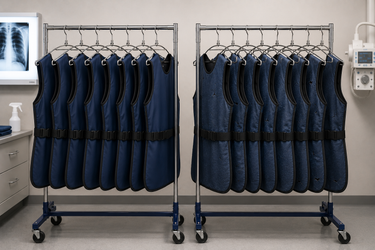
Lead aprons should be stored on dedicated hangers designed for the purpose. These typically feature wide, rounded support surfaces that distribute the garment's weight without creating pressure points. Wall-mounted racks, mobile hanger trees, and individual peg systems all work. The key is that the apron hangs fully open with no folds, bunching, or sharp bends.
Wall-mounted racks: Space-efficient and suitable for departments with limited floor space. Ensure mounting hardware can support the combined weight of all garments. A rack of 10 lead aprons can weigh 120-150 pounds.
Mobile hanger trees: Ideal for departments that need to move protection equipment between rooms. Look for units with locking casters and stable bases to prevent tipping.
Individual hooks: The simplest approach. A sturdy, rounded hook on the wall behind the door of each procedure room ensures the apron is always accessible and always stored correctly.
What Not to Do
Never drape an apron over a chair back as the sharp bend at the top of the chair creates a crease that will eventually crack. Never pile aprons on top of each other on a counter or shelf. Never fold an apron in half and stuff it into a cabinet. These common shortcuts are the leading cause of premature apron failure.
Annual Inspection Protocols
Every radiation protection garment should be inspected at least annually for internal damage. There are two primary methods:
Fluoroscopic inspection: The gold standard. Place the garment on a fluoroscopy table and image it to visualize the internal radiation-attenuating material. Cracks, tears, thin spots, and gaps are immediately visible. This method catches defects that are completely invisible on external examination.
Visual and tactile inspection: Examine the entire garment surface for tears, worn spots, stiffness changes, or exposed attenuating material. Feel along all edges and seams for irregularities. While less sensitive than fluoroscopic screening, a thorough hands-on inspection catches many problems.
Document every inspection with the date, inspector, method, findings, and disposition (pass, repair, or retire). Regulatory agencies and accreditation bodies may ask for these records.
When to Replace a Lead Apron
No garment lasts forever. Common signs that it's time to retire an apron include: visible cracks or tears in the attenuating material (detected via fluoroscopy), outer vinyl that's cracked, peeling, or delaminated, closure systems that no longer secure properly (Velcro that won't grip, buckles that won't latch), significant stiffening or changes in material flexibility, and any garment that fails fluoroscopic inspection.
A well-maintained lead apron typically lasts 5-10 years depending on frequency of use and quality of care. High-use garments in busy procedural areas may need replacement sooner. The cost of a new apron is trivial compared to the cost of inadequate radiation protection.
Building a Maintenance Culture
The best equipment in the world fails if staff don't use it properly. Post storage guidelines in procedure rooms. Include apron care in new employee orientation. Make annual inspections a scheduled calendar event, not an afterthought. When staff understand why proper storage matters and see what a cracked apron looks like under fluoroscopy, compliance improves dramatically.
Techno-Aide manufactures radiation protection garments and storage accessories in Nashville, Tennessee. We build our aprons, vests, and skirts to last, but we also know that longevity depends on care. Our team is available to help departments set up maintenance programs, select appropriate storage solutions, and establish inspection protocols.