
Pediatric Radiation Protection
May 27th 2026
Pediatric patients are more sensitive to ionizing radiation, they have more years of life ahead in which radiation-induced effects could manifest, and the technical parameters used to image them should be fundamentally different from those applied to adults. Getting pediatric radiation protection right is both an ethical obligation and a practical challenge that every imaging department must address.
Why Children Are More Radiosensitive
Children's cells divide more rapidly than adult cells, making them inherently more vulnerable to radiation-induced DNA damage. Their smaller body size means that organs are closer to the surface and to the radiation field, resulting in higher organ doses per unit of entrance skin dose. Children have decades of life ahead of them providing a longer window in which radiation-induced cancers could develop.
These biological realities don't mean that pediatric imaging should be avoided. Diagnostic imaging saves lives in pediatric care, and withholding a clinically indicated study because of radiation concerns can be more harmful than the radiation itself. The goal is to obtain the necessary diagnostic information while minimizing dose to the lowest level consistent with image quality.
Child-Sized Protection: Not Optional
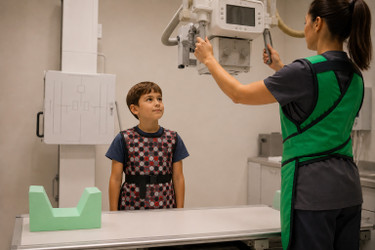
One of the most common and easily correctable problems in pediatric imaging is using adult-sized protective equipment on children. An adult lead apron draped over a five-year-old doesn't provide the same coverage geometry as a properly fitted child-sized garment. It may shift during positioning, creating gaps in shielding. It's heavy relative to the child's body weight, causing discomfort and movement that degrades image quality.
Departments that image pediatric patients should stock radiation protection garments in pediatric sizes. This includes patient aprons, thyroid collars, and gonadal shields sized for the pediatric population. The cost of maintaining a small inventory of child-sized protective equipment is minimal and the cost of not having it is real.
Technical Factors: Pediatric Protocols Matter
Adult technique charts should never be applied to pediatric patients. Children require lower kVp and mAs settings, and these should be adjusted based on the child's size — not their age. A large 12-year-old may need different parameters than a small 12-year-old.
Collimation: Tight collimation to the area of clinical interest is always important, but it's especially critical in pediatric imaging where adjacent organs are closer to the field. Collimate to the anatomy of interest and nothing more.
Grid use: In many pediatric applications, the grid can be removed. Children's smaller body habitus produces less scatter radiation than adults, and eliminating the grid allows for lower exposure settings while maintaining image quality.
Digital detector sensitivity: CR and DR systems can produce acceptable images over a wide exposure range, which means overexposure may not be immediately apparent on the image. Departments should monitor exposure indices for pediatric studies to ensure techniques aren't creeping upward.
The Image Gently Campaign
The Image Gently campaign is a collaborative initiative of the Alliance for Radiation Safety in Pediatric Imaging that provides resources, protocols, and educational materials specifically designed to improve radiation safety in pediatric imaging. Departments can take the Image Gently pledge and access free materials covering CT, fluoroscopy, interventional radiology, nuclear medicine, and conventional radiography in children.
Taking the pledge is a visible commitment to pediatric radiation safety, and the campaign's resources provide practical, evidence-based guidance that any department can implement regardless of size or resources.
Equipping for Pediatric Excellence
Techno-Aide manufactures child-sized radiation protection garments alongside our full range of adult products. Our pediatric aprons, thyroid collars, and other protection accessories are purpose-built for smaller patients, not just scaled-down adult garments. We also produce patient positioning aids and immobilization accessories designed for the pediatric imaging environment.
Protecting children from unnecessary radiation exposure is one of the most meaningful things an imaging department can do. The right equipment makes it achievable on every exam, every day.