
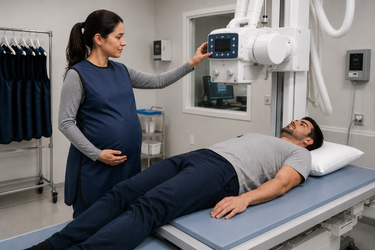
Pregnancy Radiation Protection Essentials
May 7th 2026
Pregnancy doesn't mean an imaging professional has to step away from diagnostic radiology, but it does mean the stakes of proper radiation protection become deeply personal. Whether you're a pregnant technologist, a manager supporting one, or a safety officer updating your department's policies, understanding the unique considerations for expectant mothers in imaging environments is critical.
Understanding Fetal Radiation Risks
The developing fetus is more sensitive to ionizing radiation than adults, particularly during the first trimester when organ systems are forming. The National Council on Radiation Protection (NCRP) recommends that fetal dose should not exceed 500 mrem (5 mSv) over the entire gestational period which is roughly one-tenth of the annual occupational limit for adult workers.
It's important to put this in context. Typical background radiation in the United States delivers about 310 mrem per year. A properly shielded radiologic technologist working normal duties will typically accumulate far less than the fetal limit. The goal isn't to create fear but rather to ensure that proper precautions keep exposure well below thresholds of concern.
Declaration of Pregnancy: A Voluntary Step
Under NRC regulations, a declaration of pregnancy is entirely voluntary. Once an employee formally declares in writing, the employer becomes responsible for ensuring that fetal dose remains below the 500 mrem limit for the remainder of the pregnancy.
Many facilities assign a fetal dose monitor, a second dosimetry badge worn at waist level beneath the lead apron, to track abdominal exposure specifically. This provides direct measurement of the dose most relevant to fetal protection, as opposed to the collar badge which measures the highest-exposure area of the body.
Maternity Lead Aprons: Purpose-Built Protection
Standard lead aprons provide excellent attenuation, but they aren't designed to accommodate a growing pregnancy. Maternity-specific aprons address this with adjustable panels and expanded coverage that maintain proper lead equivalency as the body changes over nine months.
Key Features to Look For
Adjustable front panels: Expandable closure systems that accommodate growth without gaps in shielding coverage. Look for designs with overlapping panels that maintain attenuation even as the apron is adjusted outward.
Full wrap-around design: Maternity aprons should provide 360-degree coverage. Scattered radiation in fluoroscopy suites can come from any direction, and the fetus deserves protection from all angles.
Lightweight materials: Pregnancy already adds physical strain. Lightweight lead-composite or lead-free materials (0.25mm Pb equivalent front, 0.25mm Pb equivalent back) can reduce apron weight by 25-40% compared to traditional lead while maintaining protection.
Proper sizing: An apron that's too tight restricts movement and may not close properly. Too loose and it shifts, creating coverage gaps. Work with your supplier to get measured at various stages if possible.
ALARA in Practice: Practical Steps for Pregnant Technologists
ALARA — As Low As Reasonably Achievable — is the guiding principle for all radiation workers, but it takes on added significance during pregnancy. Here are practical steps that departments can implement:
Rotation adjustments: Where staffing allows, rotate pregnant technologists away from the highest-exposure assignments. Fluoroscopy, cardiac catheterization labs, and portable C-arm cases tend to produce the most scatter. General radiography and computed radiography typically involve significantly lower operator doses.
Distance and positioning: The inverse square law remains the most powerful protection tool available. Maximizing distance from the radiation source during exposures by even an extra two or three feet can reduce scatter dose dramatically.
Time management: Minimize time spent in active radiation fields. Step behind barriers or leave the room entirely during exposures when patient care responsibilities allow.
Shielding: Always wear the maternity apron. Use mobile barriers when available. Position yourself on the image receptor side of the patient during fluoroscopy, not the tube side.
Supporting Pregnant Colleagues
Department managers and coworkers play a crucial role. Pregnancy is a normal life event that requires reasonable accommodations in a radiation environment and shouldn’t be treated as a problem to manage.
Ensure maternity-sized protective equipment is available before it's needed. Don't wait until a declaration to start ordering as lead times on specialty aprons can be several weeks. Build maternity aprons into your department's standard equipment inventory so they're ready when needed.
Review your department's policies annually. Confirm that your radiation safety officer has a clear protocol for handling declarations, assigning fetal monitors, and adjusting duties if monthly dose readings approach action levels.
Common Misconceptions
"Pregnant technologists should avoid x-ray rooms entirely." In most diagnostic imaging settings, proper shielding and ALARA practices keep fetal doses far below regulatory limits. Removing an employee from all duties is rarely medically necessary and can create financial and professional hardship.
"A regular lead apron is just as good." While standard aprons provide excellent attenuation, they may not close properly or provide adequate abdominal coverage as pregnancy progresses. The investment in a proper maternity apron is minimal compared to the peace of mind it provides.
"Thyroid collars protect the fetus." Thyroid shields protect the thyroid gland. Fetal protection requires abdominal and lower-torso shielding which are completely different coverage areas.
Building a Pregnancy-Ready Radiation Safety Program
The best departments don't scramble when someone announces a pregnancy. They have maternity aprons in stock, fetal monitor badges available, a written policy for duty modifications, and a culture that treats the situation as routine rather than exceptional.
At Techno-Aide, we manufacture maternity radiation protection garments alongside our full line of lead aprons and accessories that are all made in Nashville, Tennessee. Our team understands the practical requirements of imaging departments because we've been serving them for over 40 years.