
Radiation Protection Ergonomics
May 18th 2026
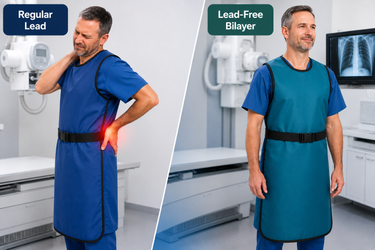
Radiation protection apparel is designed to keep people safe from one hazard, but what if the protection itself creates a different hazard? For thousands of interventional radiologists, cardiologists, orthopedic surgeons, and technologists, that’s exactly what’s happening. The aprons meant to shield them from scatter radiation are slowly destroying their backs, necks, and shoulders.
The Scope of the Problem
A traditional lead apron in a vest-and-skirt configuration can weigh between 12 and 25 pounds depending on the lead thickness and coverage area. Worn for a single one-hour case, that’s manageable. Worn for three, four, or five cases in a day adds significant cumulative load. Worn five days a week for twenty years, it becomes career-defining.
Studies on musculoskeletal injury among interventional staff have found that the majority (60–70%) report chronic pain in the lower back, cervical spine, or shoulders. Interventional cardiologists in particular show elevated rates of disc herniation and spinal degeneration compared to non-interventional peers. The protective apparel they wear daily is a documented contributing factor.
The Compliance Connection
There’s a second, less visible consequence of heavy apparel: non-compliance. When protection is cumbersome and painful to wear, people find reasons not to wear it. This doesn’t usually manifest as outright refusal, but it shows up in subtler ways:
- an apron left partially open for comfort
- a thyroid shield skipped during a short case
- a vest removed during a “break” in a long procedure while the fluoroscopy unit is still cycling.
Every one of these moments represents unshielded scatter exposure. And they compound over months and years. The irony is sharp: the weight of the protection intended to prevent radiation injury drives behaviors that increase radiation injury.
The Financial Case for Lighter Apparel
For hospital administrators and department managers, the ergonomic toll has a measurable financial dimension. Workers’ compensation claims for back injuries among interventional staff are well-documented. Lost workdays, modified duty assignments, and early career departures all carry real costs. In a specialty already facing workforce shortages, losing experienced interventionalists to preventable orthopedic injury is a significant operational risk.
When evaluated against these costs, the price difference between traditional lead and lightweight alternatives is modest. A Bilayer vest-and-skirt set may cost more per unit than a standard lead equivalent, but if it reduces injury claims, extends careers, and improves daily compliance, the return on investment is substantial.
Design Choices That Distribute Weight Better
Material weight is only part of the equation because the way that weight is distributed matters just as much. Techno-Aide’s apparel line is designed with this in mind:
Vest-and-skirt combinations split the load between the shoulders and the hips, reducing the concentrated shoulder burden of a single front apron by transferring roughly half the weight to the pelvis and legs.
Contour vests are shaped to follow the body’s natural curves, preventing the apron from hanging away from the torso and creating leverage that amplifies perceived weight.
Full wrap designs provide 360-degree coverage for staff who may turn their backs to the radiation source during procedures—important in multi-angle fluoroscopy suites.
When these design features are combined with Bilayer’s 16–40% weight reduction, the result is protection that staff can wear comfortably for an entire shift—and actually do.
A Staff Safety Investment, Not a Comfort Upgrade
The conversation about lightweight radiation protection apparel is sometimes framed as a “comfort” discussion, as if lighter aprons are a perk. They’re not. They’re a safety intervention. Reducing apron weight reduces musculoskeletal injury risk, improves wear compliance (which reduces radiation exposure), and extends the productive careers of highly trained specialists. That’s not comfort—that’s operational risk management.