
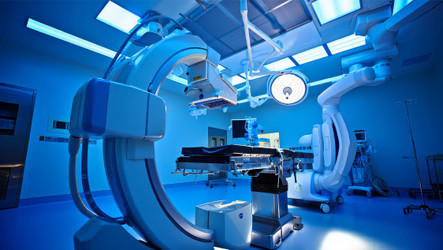
Radiation Protection for Fluoroscopy and C-Arm Staff
Apr 17th 2026
Staff in fluoroscopy suites, catheterization labs, and operating rooms face cumulative occupational radiation exposure that rivals or exceeds that of diagnostic radiologists yet many teams are inadequately shielded. This guide explains the specific dose risks during C-arm and fluoroscopy procedures and the evidence-based PPE strategy to protect your team.
Why Fluoroscopy Exposure Is Different (and More Hazardous)
C-arm fluoroscopy differs fundamentally from diagnostic X-ray imaging. Fluoroscopy delivers continuous or pulsed radiation while staff stand beside the patient performing real-time, hands-on procedures. Unlike radiologists in shielded control rooms, interventionalists, surgeons, nurses, and technicians remain in the exposure field for minutes to hours per procedure.
The result: scattered radiation, the primary exposure source for medical staff, increases with procedure duration and C-arm angulation. At one meter from the scatter source, personnel absorb approximately 0.1% of the patient's dose as scattered radiation. Over hundreds of procedures annually, this cumulative burden is significant.
The Complete PPE Stack: More Than Just an Apron
Effective fluoroscopy protection requires layered shielding. No single PPE item provides complete protection so you need all components working together.
Lead Aprons: Front vs. Wrap-Around
The standard 0.5 mm lead equivalent apron attenuates approximately 95% of scattered radiation to the shielded torso. Research comparing front-only aprons to wrap-around designs reveals that front aprons leave the back and posterior thorax largely unshielded. In clinical practice, operators frequently turn away from the C-arm to view monitors or access instruments exposing the back to unfiltered scatter.
Wrap-around aprons solve this problem. For C-arm procedures, where turning away from the beam is routine, wrap-around aprons are the evidence-based choice.
Thyroid Shields (Mandatory)
The NCRP reduced the occupational dose limit for the eye lens from 150 mSv/year to 20 mSv/year, recognizing that radiation-induced cataracts can form at doses below 100 mGy. A 0.5 mm lead equivalent thyroid collar reduces neck and thyroid dose by more than 90%. Place it before every procedure.
Leaded Eyeglasses (Essential for Operators)
Lead glasses with 0.5-0.75 mm lead equivalent reduce eye lens dose by 90%, or a factor of 5-10. Select eyewear with side protection — operators routinely turn away from the patient and unprotected side exposure negates much of the benefit.
Radiation Safety Gloves
Hands are frequently closest to the scatter source during interventional procedures. Lead-equivalent gloves (0.5 mm lead equivalent at 130 kVp) reduce hand dose effectively. However, positioning hands 20+ cm away from the image receptor remains more effective than gloves alone — use gloves as a secondary measure.
PPE Protocol by Role
|
Role |
Lead Apron |
Thyroid Shield |
Leaded Glasses |
Gloves |
Rationale |
|
Primary Operator |
0.5 mm wrap-around |
Yes |
Yes |
Yes |
Closest to beam; highest risk |
|
Secondary Operator |
0.5 mm wrap or front |
Yes |
Optional |
Yes |
Similar profile if hands active |
|
Fluoro Tech |
0.5 mm front or wrap |
Yes |
Optional |
No |
Often at control panel |
|
Circulating Nurse |
0.5 mm front |
Yes |
No |
No |
Intermittent proximity |
|
Anesthesia Provider |
Lightweight 0.25 mm or mobile shield |
Yes |
No |
No |
Positioned at head, away from beam |
Distance and Positioning: The Most Powerful Tool
Shielding is essential, but distance is your most cost-effective defense. The inverse square law is your ally: doubling distance reduces dose by 75%.
- Place the X-ray tube beneath the patient table whenever clinically possible
- Keep the image intensifier as close to the patient as possible
- Stand on the image intensifier (detector) side, not the tube side
- Use mobile shields: ceiling-mounted or portable lead-acrylic shields reduce staff dose by more than 90%
Building a Radiation Safety Culture
- Radiation Safety Training — all staff must complete accredited training before patient contact
- Dosimetry Program — whole-body and collar-level dosimetry for all operators
- Equipment Maintenance — fluoroscopy systems degrade over time; schedule preventive maintenance annually
- C-Arm Technique Audit — request a Qualified Medical Physicist to measure scatter dose rates
- Mobile Barriers — for facilities performing over 500 fluoroscopic procedures annually
|
Techno-Aide supplies complete fluoroscopy protection kits: • Full-wrap and front aprons in 0.5 mm lead equivalent • Thyroid shields with adjustable collars and secure fastening • Side-protected leaded eyewear for maximum eye lens coverage • Lead-equivalent radiation safety gloves • Mobile lead-acrylic barriers for fluoroscopy and OR suites • All manufactured in Nashville, TN | techno-aide.com |
Frequently Asked Questions
Q: Can I use a lightweight apron (0.25 mm) if I only do a few fluoroscopy cases per week?
It is not recommended. A 0.5 mm apron attenuates ~95% of scatter versus ~80% for 0.25 mm. Dose accumulates over months and years. Use the 0.5 mm standard regardless of procedure volume. If weight is a concern, choose a wrap-around design with hip support. However, many hospital radiation safety policies allow 0.25mm for fluoroscopic procedures. At these facilities, lead equivalence is based on a person’s dosimeter readings. Effective Equivalent Dose (EDE) ≈ (0.04 x collar dose) + (1.5 x waist/under-apron dose).
Q: Do I need leaded glasses if I'm wearing a lead apron?
Yes. The apron protects your torso, not your eyes. The eye lens is radiosensitive; the ICRP dose limit is only 20 mSv/year. Leaded glasses reduce eye dose by 90%. Non-negotiable for operators whose eyes are within 12-18 inches of the fluoroscopy field.
Q: Should I wear my dosimeter under my lead apron or over it?
The ICRP recommends wearing two dosimeters: one under the apron (body dose) and one at collar level above the apron (eye lens dose). A single dosimeter under the apron significantly underestimates eye and thyroid dose.
Q: What is the recommended distance from the C-arm for staff not directly assisting?
Circulating nurses and anesthesia providers should maintain maximum practical distance — ideally over 6 feet (2 meters). At 6 feet, scatter dose is reduced to approximately 2.5% of the exposure at 3 feet, per the inverse square law.