
Radiation Protection Needs for Veterinary Staff
Apr 17th 2026
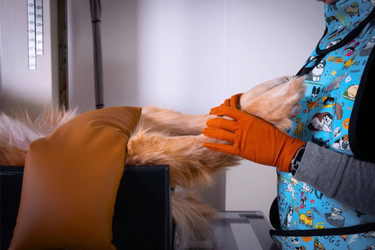
If your veterinary practice takes radiographs, your staff faces daily radiation exposure, and the risks are different from those in human medical settings. Unlike human patients who can follow positioning instructions and hold still, veterinary patients require manual restraint, which forces your technicians and assistants into close proximity with the x-ray beam.
Why Veterinary Radiation Protection Is Different
Human radiography relies on automated positioning, sedation, and patient cooperation. Veterinary radiography doesn't have those luxuries. A frightened or uncomfortable animal won't cooperate with precise positioning which causes your team to hold the patient still by hand, often directly in the path of scatter radiation.
This creates a unique exposure challenge: veterinary staff routinely work closer to the radiation source than almost any other occupational group. A tech performing 10 to 15 radiographs per day, five days a week, accumulates significant annual exposure.
Regulatory Framework: What You Must Know
- Personal dosimetry is mandatory: all staff involved in radiographic imaging must be monitored with personal dosimetry badges. Federal exposure limit: 5,000 mrem (5 rem) per year
- Written protocols required: your clinic must have documented radiation safety procedures and clearly marked radiation areas
- Equipment maintenance: lead-lined PPE must be inspected for integrity at intervals not exceeding 24 months
- State oversight: your state may require equipment calibrations, performance evaluations, and periodic inspections
Essential PPE for Veterinary Radiography
The ALARA Principle
The foundation of all radiation safety is ALARA: As Low As Reasonably Achievable. This means minimizing time (exposure duration), maximizing distance (stepping back when possible), and utilizing shielding (lead aprons, gloves, thyroid shields, and eyewear).
Minimum PPE Requirements
For any veterinary staff member present during radiographic procedures:
- Lead apron or protective gown (minimum 0.25 mm lead equivalent; 0.5 mm recommended for table-side work)
- Thyroid collar (0.5 mm lead equivalent minimum)
- Lead-impregnated gloves (fully enclosing, worn on the hands, not draped over them; 0.25 to 0.5 mm lead equivalent)
- Lead glasses (if the face will be close to the scatter source)
Choosing the Right Lead Apron for Veterinary Use
Lead Equivalency
- Standard (0.25 mm Pb): Lower cost, lighter weight. Acceptable for general work at distances beyond 1 meter
- Premium (0.5 mm Pb): Best for table-side work and frequent restraint. Provides 96.5% attenuation against high-intensity scatter
Weight and Fit Considerations
- Adjustable straps and sizing options are critical for clinics with part-time staff of different sizes
- Lightweight or lead-free alternatives (composite materials offer protection with 25-30% less weight)
- Ergonomic design that distributes weight across the shoulders and hips
Lead-Free Options
Lead-free protective apparel is gaining adoption in veterinary clinics. These aprons offer comparable protection with 25-30% less weight, reducing fatigue and improving compliance. Techno-Aide manufactures both traditional lead and lead-free options in multiple sizes, suitable for individual clinics and multi-location practices.
Beyond Aprons: Positioning Aids and Hands-Free Techniques
Federal guidelines recommend that veterinary staff avoid regular manual restraint when possible. Simple, inexpensive positioning tools can reduce your team's exposure dramatically:
- Sandbags and half-filled bags to position limbs and support body contours
- Velcro-style extremity straps for non-painful animal positioning
- Foam troughs and wedges for spinal and chest radiographs
- V-troughs and positioning boards for specific anatomical areas
- Light sedation when clinically appropriate allows better positioning with zero manual restraint
PPE Recommendations by Procedure Type
|
Procedure |
Lead Apron |
Thyroid Shield |
Gloves |
Glasses |
Restraint Method |
|
Dental |
0.25-0.5 mm |
Required |
Required |
Recommended |
Positioning aids or light sedation |
|
Thoracic/abdominal |
0.5 mm |
Required |
Required |
Recommended |
Sandbags + minimal hands-on |
|
Spinal |
0.5 mm |
Required |
Required |
Optional |
Foam wedges + positioning board |
|
Extremity |
0.25-0.5 mm |
Required |
Required |
Optional |
Sandbags or straps |
|
Techno-Aide radiation protection for veterinary practice: • Lead aprons, thyroid shields, and gloves for veterinary clinics • Multiple sizes — lead and lead-free options • Solutions for individual clinics and multi-location practices • Nashville, TN | Made in the USA since 1977 | techno-aide.com |
Frequently Asked Questions
Q: How often should I replace lead aprons?
Aprons don't need replacement if they remain intact. Inspect every 24 months for cracks, separation, or damage. Replace only if damage is found.
Q: Do I need dosimetry badges for every staff member?
Yes, if they work in or near the radiography room. Badges should rotate quarterly or monthly depending on your state's requirements. Review dosimetry reports annually with your team.
Q: Can my small-animal clinic get by without lead gloves?
No. Hands receive the highest scatter doses during manual restraint. Even brief exposure accumulates over a career. Use lead-impregnated gloves every time you restrain a patient during radiography.
Q: Do I need to train my staff on radiation safety?
Yes. OSHA and the AVMA recommend documented training for all staff involved in radiography. Topics should include the ALARA principle, time/distance/shielding, proper PPE use, and emergency procedures. Document this training in personnel files.